
This is great we think – it is from a 1980s book of arial photographs of the British landscape. It seems to be a kind of pattern made in a Welsh (UK) estuary mudflat by a moored boat being repeatedly lifted and grounded on a mudbank by the tide. There seem to be a few of them.
With the artist Heather Green, we have decided to call these ‘tidal spiralgraphs’. Other examples, in Korea, can be seen here on Instagram. (Thanks to Heather for link).
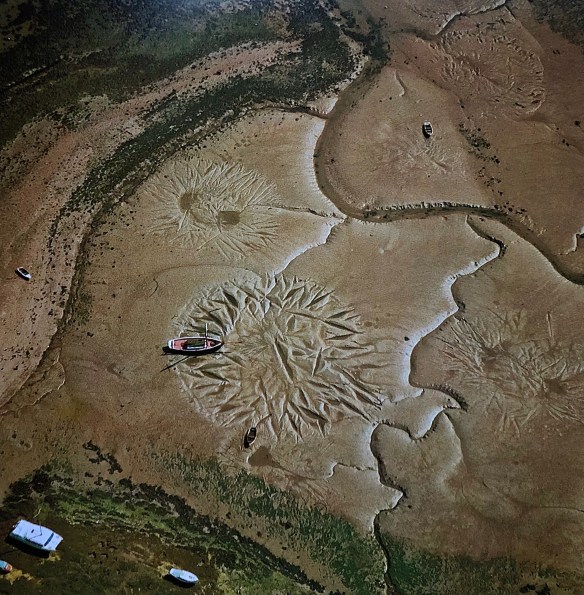 This is in Angle, Dyfed, Wales.
This is the book this is from, by Bernard Stonehouse, published in 1982. Although just about the British Landscape there are a lot of coastal pics of intertidal areas, e.g. the ones below


 Tidal Cultures
Hi, Owain (and others in the team),
Philip Gross here – estuarine poet (Water Table, etc) from Penarth…
I’m liking looking in to the Tidal Cultures posts, and seeing this latest one makes me want to ask you: what do you make of these apparent labyrinth-petroglyphs seen in the mudstone exposed at low tide in Penarth. (OK, I admit, I’ve also asked the petrology people at the National Museum of Wales this question, and had a thoughtful reply… but what would you think?)
Philip
>
Hi Philip. Lovely to hear from you, and thanks for your interest in the Tides Blog. Of course The Water Table is featured on it. I also wrote a paper in Environmental Humanities Journal which used bits of that. I am not sure about labyrinth-petroglyphs, will check it all out. Do share whatever answer you get from the museum. Did you know that Cerys Matthews read Severn Song on her BBC 6 Music show, with an accompanying piece of music? And she used that on her Radio 4 With Great pleasure programme? That was on my prompting. Cheers Owain