The Petitcodiac River and the Legend of the Tidal Bore Moncton, New Brunswick, Canada, by Michael Martin
see here
Sample picture


The Petitcodiac River and the Legend of the Tidal Bore Moncton, New Brunswick, Canada, by Michael Martin
see here
Sample picture
I have added a link to the Sustainable Eel Group to the links on the home page.
This group are committed to developing sustainable management of seas, rivers and estuaries in order to help eel population recovery. Great vision and energy.
http://www.sustainableeelgroup.com/

Previewing the UK’s highest tides in 25 years that are set for 29/30 September, this talk will place the enormous tides of South West Britain in a global context.
Venue: Room TC001, School of Natural & Social Sciences, University of Gloucestershire,
Francis Close Hall Campus, Cheltenham, GL50 4AZ.
Places: free, no booking necessary.
Great Sea Shanty Group in Bristol who tll tales – sing songs – anbout the pilot cutters and much more
http://roaringtrowmen.co.uk/pilotcutters/http://roaringtrowmen.co.uk/pilotcutters/
Tenby is a long-loved holiday destination for us.
We always try to book holiday when the tides are high/low. This makes bigger beaches; dramatic scenes; opens up great low-tide walks; and high tide swimming possibilities.
This map charts some of these (not all are tide related but this is a tidal kingdom overall)
Estuaries are very rich and complex habitats with a mix of processes, flows and exchanges between aquatic and terrestrial biodiversity. Brackish waters, (mix of salt and fresh water) and turbid waters (waters carrying silt etc) form unique, locally very varied and dynamic habitats. Inter tidal zones are some of the most biodiverse habitats known. So to build large tidal lagoons which radically change / degrade these conditions is an overwriting of rich, complex biodiverse landscapes for the sake of development. To me this parallels the clearing of rainforests for such purpose as palm oil production. This is rightly a cause for worldwide environmental concern, boycotts and campaigns (links below). Tidal lagoons (and barrages) should be seen in the same light. Yes, green / renewable energy is vitally important, but there are much better ways of going for that. Lagoon and barrage energy is not green energy it is ‘dirty’ energy.
See here for more on plam oil
http://www.greenpeace.org.uk/forests/palm-oil
http://www.scientificamerican.com/article/harvesting-palm-oil-and-rainforests/
What a nightmare vision is offered by the new tidal lagoon proposals on the Severn Estuary
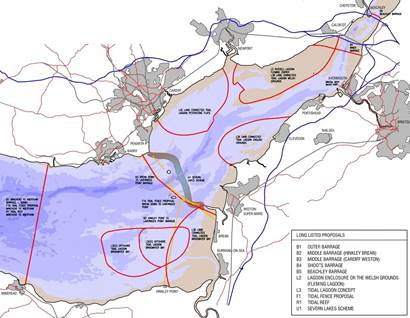
Barrages and lagoons are very grim and environmentally destructive projects. The Severn Rivers Trust have calculated that power from the proposed Swansea lagoon will be the most expensive electricity in the world!! As usual in the UK, plans such as these are delivered by decision making systems in thrall to developers who want to make profits at the expense of the living environment. The Taff barrage being a very shocking example of that. In Canada / Bay of Fundy, where tidal power and its impacts have been studies for decades, Tidal Stream power is now the focus. Barrages and lagoons are the dinosaurs of tidal power technology. PLEASE do look at this website and move towards arguing for tidal stream power generation which will not involve destroying huge areas of an internationally important habitat.
http://acer.acadiau.ca/FERN.html.
Also tidal stream power could be one of THE green energies worldwide. There are development programmes in Scotland, Canada and elsewhere, if you are looking to develop the green economy that is where the potential is.
This is also added to our tidal films page
Bristol – highest tidal range in a populated area anywhere in the world http://t.co/BSdPdQqkSz @GeorgeFergusonx @AliRVowles @DesperateMen
— Bristol Loves Tides (@Tides_BLT) May 22, 2015
This blog accompanies a public Google map, and together they form the Severn Estuary Art Atlas (SEAA) .
This aim is to show the location and content of a number of artworks which have been created in and around the Severn Estuary, and to reveal this extraordinary landscape through artworks created with(in) it.
Each artwork/project/event/artist has a dedicated page on this blog (see above) and these link to place markers on the accompanying Google map. In some instances a generic placemaker is used on the map for works which are not spatially specific.
This project relates to other academic work I have created on the Severn Estuary, tidal landscapes and ‘tidal culture’. (The Breath of the Moon).
This work has been developed with the help and support of a number of people. Thanks to Michaela Riser, Natasha Barker, Davina Kirkpatrick, Iain Biggs, Stuart Ballard, Antony Lyons, Suze Adams…
View original post 8 more words
“High Tide Clean Up” Borth & Ynyslas Beach Clean https://t.co/0eWv3kvFKX
— Hydrocitizenship (@Hydrocitizens) April 16, 2015
I like this tweet and the idea of a high tide beach clean. I guess the incoming tide will pick up all stuff like plastic and there it is for gathering on the high water line!

 Tidal Cultures