BBC Radio 4 Programme about the ‘Pill Hobblers’; tidal river boatmen of Bristol-

BBC Radio 4 Open Country: The Pill Hobblers

Should be listenable to on-line for some months – but maybe only in the UK

“For this week’s Open Country Helen Mark explores the fascinating world of the Pill Hobblers – the ‘boat men’ who for centuries have risked their lives to keep ships safe on the River Avon.

The Pill Hobblers are known to have existed from at least the 17th centuary and still provide the linesmen who handle the lines for all shipping coming through the locks and onto the quaysides at Avonmouth and Royal Portbury Docks. Alongside the ‘Pill Pilots’ (the skilled navigators who guided ships through the waters) the Hobblers of today still work much as they did hundreds or years ago, working the ropes to secure and release ships into the Bristol Channel.

The Hobblers are still required to live in Pill – the small North Somerset Village that generations of Hobblers have come from – to ensure swift access to the nearby docks so that they can be on hand 24 hours a day, seven days a week to tend to the ships just as they always have been.

Whilst visiting the village of Pill itself and The Royal Portbury Docks, Helen meets with Hobblers and Pilots – past and present – to hear how generations of local men have kept ships sailing – and trade flowing – safely into the 21st Century, come rain or shine.”

Presented by Helen Mark. Produced by Nicola Humphries.

BBC Radio Programme about The Morecambe Bay 2004 cockle picking disaster. Online for 30 days

“Alan Dein visits Morecambe Bay to investigate the aftermath of the 2004 cockle picking disaster. How did the community cope when 23 Chinese workers lost their lives in the bay?

The third programme in the Aftermath series, which explores what happens to a community after it has been at the centre of a nationally significant event.

Morecambe faced its greatest tragedy in February 2004, when a group of Chinese cockle pickers drowned in a bay notorious for its dangerous tides. The event brought to the country’s attention issues of people-trafficking and illegal gangmaster activity. As the media of the world descended, reported and left, the shock felt by locals lived on. Alan Dein looks at how the community changed as a result.”

Some detailed descriptions of what happened –  and the tidal landscape itself. Link here

I, by The Tide of Humber; BBC Radio 4; Poetry and commentary by poet Sean O’Brien

From the BBC website –  where the programme is available for a while

“BBC coverage of Hull City of Culture will be extensive across 2017. At its very start, the award-winning poet Sean O’Brien reflects upon why his native city, its waterscape and landscape, have inspired poets past and present.

The programme features a specially commissioned new poem from Sean – a three-part memory-piece, which is also a love-song for Hull, its surroundings and their metaphorical resonance:

……..The great void
Where the land loses track of itself,
And the water comes sidling past at the roadside

Awaiting the signal to flood, is a kind of belief
Where there is no belief, is the great consolation
Of knowing that nothing will follow but weather and tides,

Yet also that when the world ends
There must be a Humber pilot keeping watch
As the great ships are passing silently away

Through the estuary’s mouth and the saw-toothed marriage
Of river and sea, and out past the fort at Bull Island
And over the edge, and away………….

Sean also celebrates the work of poets who have made the city their home: Andrew Marvell, a line from whose 17th Century poem, To His Coy Mistress, gives this programme its title; Philip Larkin, Stevie Smith and others. He brings in an eclectic range of music, including his personal favourite, Dirty Water, by local band The Fabulous Ducks.

He hears from the Hull-based geographer Chris Skinner, and poet Sarah Stutt.

Starting with memories of digging holes in the garden of the house where he grew up, via flood-cellars, culverts and drains, the smaller river Hull and the great estuarine river Humber itself, this highly-textured programme culminates with Sean at the top of the disused lighthouse at Spurn Point, gazing out into the North Sea.”

Great quote about the psychogeography of tides – in Hull

This BBC Radio 4 programme Hull Before Culture  Thursday 5th Jan 2017 opened with these words

“I always think this about Hull – when the tide is in – you can feel that across the region – you can feel that, kind of, energy. But when the tide is out, it kind of drains the emotion of the people as well. It certainly does me.”

Spoken by programme present John Godber

This chimes very well with a number of literary accounts of the affective airs of high and low tides.

Call for Panels – III CHAM International Conference “Oceans and Shores: Heritage, People and Environments”

Owain Jones's avatarA blog about the environmental (ecological) arts & humanities

Via H-Net

—————–

Call for Panels – III CHAM International Conference “Oceans and Shores: Heritage, People and Environments”

by Alice Santiago Faria

Your network editor has reposted this from H-Announce. The byline reflects the original authorship.

Type:  Call for Papers

Date: July 12, 2017 to July 15, 2017

Location: Portugal

Subject Fields: 

Art, Art History & Visual Studies, Cultural History / Studies, Environmental History / Studies, History of Science, Medicine, and Technology, Urban History / Studies

The III CHAM International Conference will be held in Lisbon, 12th  to 15th July 2017, and its main theme is “Oceans and Shores: Heritage, People and Environment”.

The call for panels is now open. The deadline for proposals is 5th December.

Concept

Coastal seas and open oceans have always been a realm for epic adventures, for misfortunes and new discoveries, a place for the construction of stories and legends, and for the creation of…

View original post 334 more words

Tidal Pooh Sticks

We can’t quite claim to have invented this idea because it is mentioned here.

But it is a rare and noble variation of Pooh Sticks (which we thought of too) which we think should be developed.

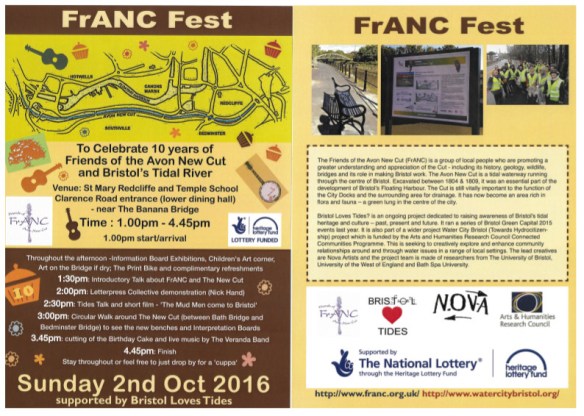
We played it with people of Bristol as part of

franc-fest-poster-oct-2nd-16

We were throwing sticks of the famous Banana Bridge over the Avon New Cut, to get people to see just how fast the tide was flowing – and which way!! Ebbing?? Flooding??

Now a variation of tidal pooh sticks we want to develop is a longer version of the game. But we have still to test this. If one picks one’s moment – using, of course, a tide timetable, one could throw a stick into the river , watch it float with the tide under the bridge as usual, but do this soon before the turn of the tide, and then maybe in a while it will float back the other way!