It is of some comfort to know that at least some people look at this site. Thanks to all.

It is of some comfort to know that at least some people look at this site. Thanks to all.
Seahenge we discovered when sea and tidal forces removed sand from Holme beach in Norfolk, revealing remains of an ancient structure.

This text is from the website of the Norfolk Museum Collection
In the summer of 1998 the shifting sands of Holme beach on the north Norfolk coast revealed something extraordinary. Preserved in the sand were the remains of a unique timber circle dating back over 4000 years, to the Early Bronze Age. Although discovered on a modern beach, the circle was originally built on a saltmarsh, some way from the sea. The timbers were arranged in a circle 6.6m (21ft) in diameter, comprising 55 closely-fitted oak posts, each originally up to 3m (10ft) high. The site became known as ‘Seahenge’.”
The timbers were removed from the beach, preserved, and then put on permanent display in King’s Lynn Museum.

Source and other images here.
A BBC Radio 4 ‘Open Country’ programme about Seahenge is available here.
The programme describes the discovery, the challenges of the archaeology which had to be done between one high tide and the next, the age of the structure, its probable origins, and move to the museum.
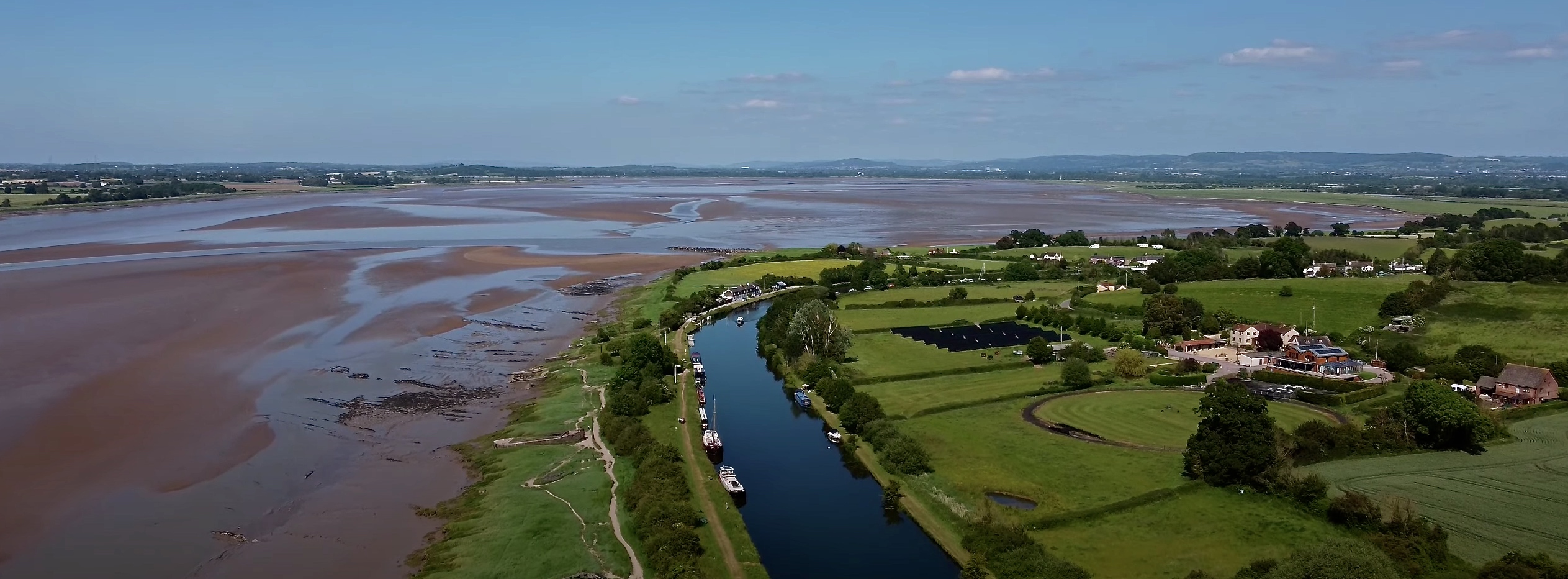
Mid/upper Severn Estuary – low tide.
Introduction
This blog is about tidal cultures. These are the amazing natural and cultural ecologies that are shaped and entangled by tidal rise and fall at the margins of the oceans. Tidal cultures are present in all coastal landscapes where tides rise and fall. They are particularly rich in highly dynamic tidal landscapes such as estuaries, where tides can raise the sea level many metres in a matter of hours and then lower it again. Often huge areas of inter-tidal land are repeatedly exposed and then inundated through this process. Tidal cultures are thus cultures of the coast, of where the margin between land and sea is always on the move. Tides are some of the most powerful forces on Earth, and, as well as constantly changing the sea level, create powerful currents and other oceanic processes which also shape ecology, culture and economy. Tides, and therefore tidal cultures, have complex daily, monthly, and seasonal cycles driven mostly by the gravitational relationship between the earth, sun and, most importantly, the moon. Other forces and factors also affect tidal processes and rhythms, such as the spin on the earth, and the varying geomorphology of coasts around the world.
A longer description of my life with tides can be found here.
Research and Writing About Tides, Coasts and Estuaries
I am available for frelance journalism, media comment and research about tides, coasts, estuaries, and tidal cultures in the UK and beyond. Particulalry in the context of climate change and sea level rise which pose huge challenges to coasts, estuaries and wetlands in the UK and around the world in the coming decades. Please email me at owain.oj.jones(at)gmail.com or call / message 07871 572969.
Collaberations
Through my academic work on tides and estuaries, and through this blog, I have been lucky enough to collaborate with a number of artists / scholars on various talks, papers and projects. These people include; Simon Read; Linda Cracknell; Bettina Van Hoven; Louisa Fairclough; Antony Lyons; Davina Kirkpatrick; Natasha Barker; Michela Palmer; and Christoph Potting .
I am currently undertaking a substantial collaboration with Heather Green of Arizona State University on a project entitled Tidal Timespace see here.
BLOG CONTENT
Posts
The blog now consists of over 150 posts which are updates and links to tidal cultural news and points of interest. Pleasse scroll down to browse, or search for any key words you are interested in.
The fisrt post (bottom) – https://tidalcultures.wordpress.com/2013/04/02/tidal-cultures/ – tells of the research exchange grant that funded the initial project which this blog emerged from.
Pages
There are 26 pages in all. These contain a lot of varied material including more details of the funded resreach project and the research exchange workhops that were held in the UK and the Netherlands, and various writings by me and others. Please note some pages are grouped and appear in dropdown lists from their parent page.
The main pages of the blog are:
Tidal Glossary. This lists over 150 words and phrases connected to tidal porcesses and places. Many of these are old, local, and/or traditional terms. The glossary leans towards a more poetic that scientific view. There being many technical, scientific terms relating to tides that are not included.
Tidel Related Artworks. This lists over 100 artworks from around the world which are related to tides. This does not include paintings and drawings (there would be many thousands) but lists sculptures, perfomances, films and installations which are inspired by, or connected to, tidal ride and fall in places all around the world. Each entry has a link where possible.
Non-Fiction Books About Tides and Tidal Places. This lists more than 50 non-fiction books which discuss tides, tidal processes, places and histories. Each entry has a link where possible.
The World’s Highest Tides. And Some Other Tidal Facts and Figures
Other pages
Papers, Talks and Other Output On Tides by Owain, sometimes with others.
About The Author; Professor Owain Jones.
I grew up on a farm near the Severn Estuary (UK). Since then I have lived in places near the estuary all my life. This sparked my interest in tides.
I gained an MSc (Society and Space) and PhD in Cultural Geography at the world leading Department of Geography, University of Bristol; 1993-1997. I then conducted post-doctoral research at Bristol, Exeter, and Open Universities, and other institutions. In series of RCUK (now UKRI) funded projects, I worked upon many aspects of nature-society relations; landscape, place and memory; the environmental crisis; children’s geographies; theories of pragmatism and non-representation. I have conducted research projects on water and society (floods, tides, coastal cultures, water and community; on trees, place and landscape; and children, nature and place. I led a £1.5 million Arts and Humanities Research Council Connected Communities project which involves eight UK universities, and numerous community partners and artists in four case study areas across the UK. This project sought to creatively explore and transform connections within and between communities, and communities and nature, in relation to water issues, inclsuing, in the Bristol case study, tides. I was appointed as the first Professor of Environmental Humanities in the UK in 2014 at Bath Spa University where I was deputy director of Research Centre for the Environmental Humanities. (2016 – 2019).
I have published/co-published over eighty scholarly articles. See Academia.edu for a list – many papers can be downloaded.
I have also published five books as a editor and/or co-author.
Pigott, A, Jones, O, Parry, B (Eds.) (2023) Art and Creativity in an Era of Ecocide: Embodiment, performance, practice, London: Bloomsbury.
Holt Y., Martin-Jones D., Jones O. (eds) (2018) Visual Culture in the Northern British Archipelago: Imagining Islands, London: Routledge.
Bastian M., Jones O., Moore N., Roe E. (eds) (2017) Participatory Research in More-than-Human Worlds, London: Routledge.
Jones O., and Garde-Hansen, J. (eds) (2012) Geography and Memory: Identity, Place and Becoming, Basingstoke: Palgrave Macmillan.
Jones O., and Cloke P. (2002) Tree Cultures: The Place of Trees, and Trees in their Place, Oxford: Berg.
A list of all the blog pages as links
A (Poetic) Tidal Glossary
A Conversational Essay on Tides by Linda Cracknell and Owain Jones
About this Blog And Contact Details
Cardiff’s Rivers and Coastline (a lament)
Detailed Aims and Objectives (of funded project)
Links to Tidal Films and Websites
Low Tide Walks
Managing Tidal Change: Natasha Barker Reports
Non-Fiction Books on Tides and Tidal Places
Overview of the Servern Estuary and its natural and cultural heritage (and list of refs)
Owain Jones on Tides: Introduction
Papers, Talks and Other Output
Picture Store and Maps
Severn Estuary Art Atlas (SEAA) and Wadden Sea Art Atlas (WSAA)
Severn Estuary Scouting Trip; Heather Green and Owain Jones; 9 – 15th January 2020
Simon Read on Tides
The World’s Highest Tides. And Some Other Tidal Facts and Figures
Tide Related Art Works
Tides in Folklore and Literature
Tides in Poetry
Tides in Songs
Views of the Wadden Sea
Workshop 1. “Getting to know you…”
Workshop 2: “Emotional Geographies of the coast; island imaginings and mud walking!”
Workshop 3: “Deeper into the Servern landscape(s)”
Workshop 4: “Sense of Place, Terschelling”
New entries added to:
Tidel Related Artworks. There are just about 100 entries now.
Tidal Glossary. About 140 words and phrases.
Non-Fiction Books about tides and tidal places. Getting on for 50 books listed
These are three of the main pages in this blog.
14. 12. 2022
Like many others I am so shocked and saddened by the death of Jon Beedell. I was lucky enough to be involved in various enterprises with Jon and The Desperate Men. Deepest sympathies to all his family, friends and colleagues. As a tribute please I have assembled as much of the fabulous Proxi and Peri films and photos that I can find.
Please note this was a large creative enterprise running over a few years in Bristol approx. 2015 – 2017, with input from various individuals and organisations.
Here is information from the Desperate Men website as a screen shot.
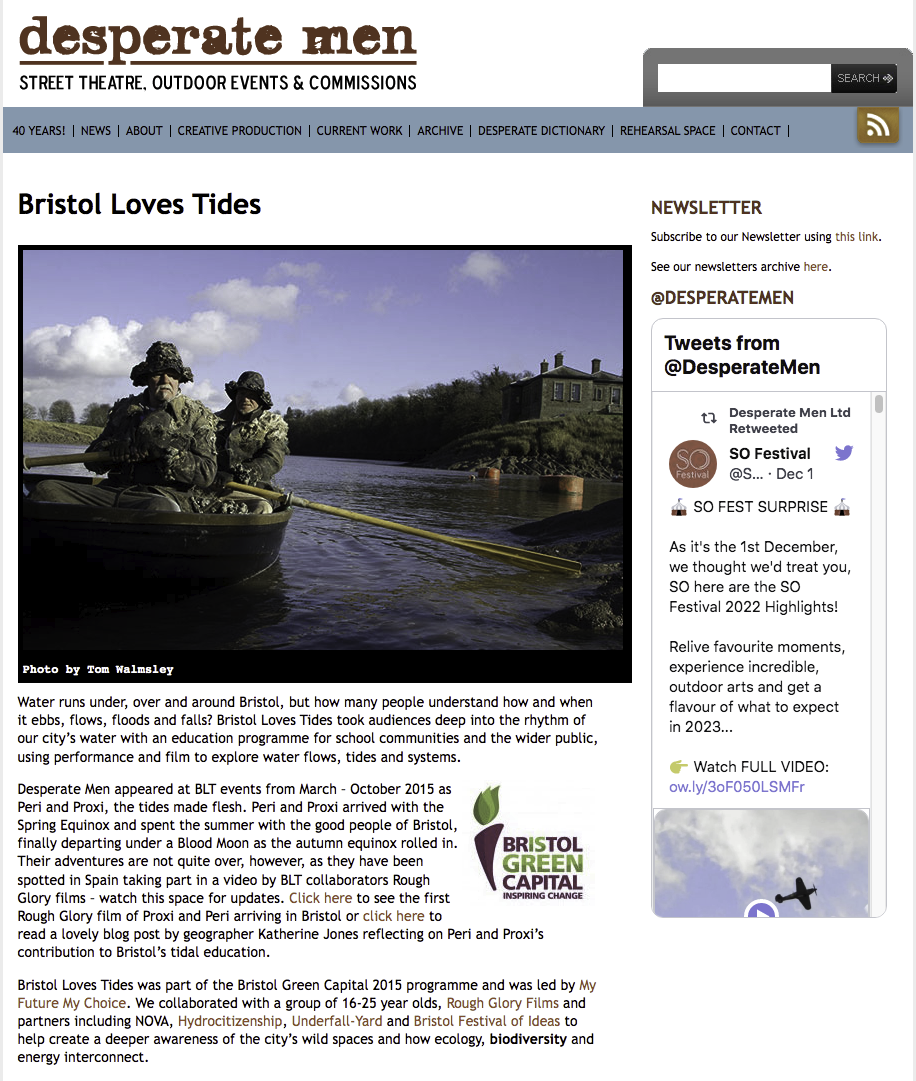
Please also note that much of this is also on the My Future My Choice, Bristol Loves Tides website here. But other films and photographs filmed for the Towards Hydrocitizenship: Water City Bristol Project are also included.
Special credit is due to:
Richard Headon who is co-artistic drector of Desperate Men with Jon Beedell, and who was Proxi to Jon’s Peri
Hugh Thomas of My Future My Choice
Nathan Hughes / Roung Glory Films who made most of the films below.
Antony Lyons /Nova Arts who were creative inspirations at the outset.
Proxi & Peri: One Last Job. Film 1
Proxi and Peri, ‘the tides made flesh’, are compelled by the moon, to venture up the River Avon to remind the people of Bristol of the importance of tides to the heritage, history, and possible futures of their city. Redoutable blue-collar workers, they’ve successfully managed the second largest tidal reach in the world since the 1607 Tsunami, but must complete one last job before retiring to the Mediterranean. Commissioned by My Future My Choice for Bristol Loves Tides – a European Green Capital 2015 flagship project raising public awareness of hydro-citizenship (ecologies of people, water and cities). Made in association with the Towards Hydrocitizenship AHRC project and NOVA arts.
This video has to be watched on Vimeo – click on the image below to do that.

Proxi & Peri: Syzygy Oath on Bristol Docks (2015): Film 2
Proxi and Peri Proxi and Peri (Tides Made Flesh) arrive in Bristol on the syzygy (a nearly straight-line configuration of the sun, moon, and earth during a solar or lunar eclipse) to be welcomed by the Mayor. They lead the assembled throng in a tidal oath, present 10 tidal ambassadors with special objects and charge them to conduct important research. Launch event for Bristol Love’s Tides – a flagship, Bristol European Green Capital 2015 project featuring Desperate Men as P&P.
This video has to be watched on Vimeo – click on the image below to do that.
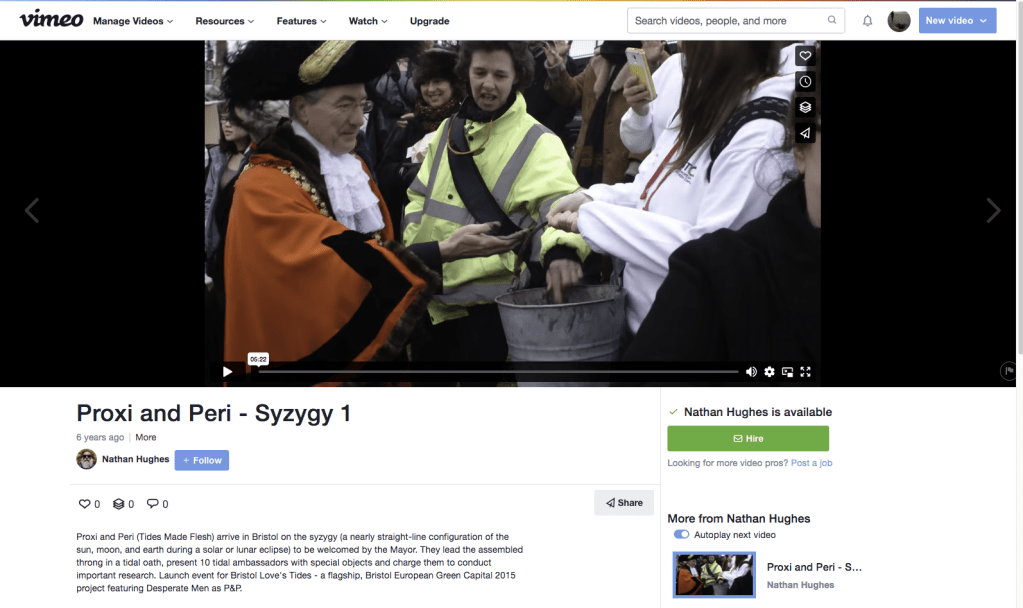
This is a shorter version, just of the oath.
Proxi & Peri: Ebb of Life. Transcript: Film 3
Proxi & Peri: No Rest For The Fluid. Film 4
Proxi and Peri, ‘the tides made flesh’ wake on a bleak shore, surprised to still be human, as they anticipated a well-earned retirement managing marginal Mediterranean tides. They cross a hostile landscape to ask the moon why she reneged on their deal, and argue the pros and cons of being human en route. Commissioned for Bristol Loves Tides, the film pays homage to buddy movies and Spaghetti Westerns to raise questions about our highly problematic relationship with non human systems.
This video has to be watched on Vimeo – click on the link below to do that.

Short Films
The tides have been put into human form by the moon and are on a quest to find out how Bristol values its tides which are the highest of any city in the world. This film explains the six themes that they challenge young people to find out about.
Proxi and Peri ask about Heritage
Proxi and Peri ask about Water
Proxi and Peri ask about Bio Diversity
Proxi and Peri ask about Energy
Proxi and Peri give their Scores
Peri Sings a Song
Extracts form Tidal Turnings: The Continued (Bristol) Adventures of Peri and Proxi
Photographs of Events
Album of photographs of Proxi and Peri at the Benjamin Perry Boathouse, Bristol Docks, 2015

Click on image below to see all photos

Photos of World Water Day Event 2015

Click on image below to see all photos

Related academic article
By Owain Jones and Katherine Jones
A chapter in the book Methodological Challenges in Nature-Culture and Environmental History Research. 2016; editors Jocelyn Thorpe, Stephanie Rutherford, L. Anders Sandberg
Chapter abstract
This is a story about tides, about tides in Bristol, about two characters that were found in the mud of the Severn Estuary-Peri and Proxi. It is also a story about telling stories as a method for the creative accounting of eco-social histories, presents and futures, and material and non-material entanglements of such through space-time. And it is a story about loss: of ecologies, of ecocide, of getting lost, and of finding a way through stories. As so much of life is, this is an experimental mixing. Tides mix things-fresh
and salt water, land and sea. In unsettling boundaries and definitions, they invite a focus on inter-relationships, and on flux and change. Intertidal landscapes are in constant motion, change and cycles, denying fixity and stasis. As such, they unsettle both linear thinking and linear understanding that, in spite of movements to break away from them, continue to shape historical and geographical accounts in many areas of thinking. This chapter is tidal in its approach-ecological. It tells stories of stories
through the tides, an ebbing and waning, from solid to fluid and back again with all that comes in between. It embraces the constant motion of life and understanding, and attempts to bring this into a textual representation. In short, it is a story of an ecological approach to eco-social storytelling.
This is the Project Blog for
‘“Between the Tides”. Comparative arts and humanities approaches to living with(in) intertidal landscapes in UK & the Netherlands. Learning from those who live and work with complexity, change and fragility’. 2012 – 2014.
Funded by – The Netherlands Organisation for Scientific Research (NWO) and Arts and Humanities Research Council (AHRC) (UK) Humanities Research Networking and Exchange Scheme.
Principle Investigator: Owain Jones; Professor of Environmental Humanities; School of Humanities and Cultural Industries: Bath Spa University.
Co-investigator: Dr. Bettina van Hoven; Department of Cultural Geography, Faculty of The Spatial Sciences, University of Groningen.
The blog will record workshop activities and links to various aspects of tidal culture.
Any tidal references or other information is very welcome. Please email Owain at owain.oj(at)btinternet.com

 Tidal Cultures