We have just added this very cool looking thing to our Tide Related Art Projects Page
Flood House – all credits can been found via the above link


We have just added this very cool looking thing to our Tide Related Art Projects Page
Flood House – all credits can been found via the above link

 <
<


This is from a very good website describing what tides are and how they work
National Ocean Service (USA)
Tides play a great role in this story
The Aquapelago and the Estuarine City: Reflections on Manhattan
This is a great paper on the watery / estuarine pasts (and futures) of Manhatten
Thanks to Kaisa Schmidt-Thomé for the link
By Philip Hayward; School of Communication, University of Technology, Sydney and Division of Research, Southern Cross University, Lismore
It contains these great descriptions of the pre-development landscape and the dynamics of an estuary – Hayward is quoting Sanderson (2009)
If Mannahatta existed today as it did then, it would be a national park – it would be the crowning glory of American national parks. […] Mannahatta had more ecological communities per acre than Yellowstone, more native plant species per acre than Yosemite, and more birds than the Great Smoky Mountains National Park. Mannahatta housed wolves, black bears, mountain lions, beavers, mink, and river otters; whales, porpoises, seals, and the occasional sea turtle visited its harbor. Millions of birds of more than a hundred and fifty different species flew over the island annually on transcontinental migratory pathways; millions of fish – shad, herring, trout, sturgeon and eel – swam past the island up the Hudson River and in its streams during annual rites of spring. […] Oysters, clams and mussels in the billions filtered the local water; the river and sea exchanged their tonics in tidal runs and freshets fueled by a generous climate; and the entire scheme was powered by the moon and the sun, in ecosystems that reused and retained, water, soil, and energy, in cycles established over millions of years.
History, geography, and climate all set Mannahatta up to be a biological success, but what makes Mannahatta wealthy beyond imagination is its crowning position atop an estuary… By definition, estuaries are the places where the land and sea come together, and the result is like currency, both productive and variable. Freshwater rivers, like the Hudson and the numerous streams that are her sources and tributaries, discharge nutrients to fertilize the water, and cut the saltwater with fresh flow. As the seasons turn, the amount of freshwater swells and diminishes, and as the days and nights pass, the tide rises and falls. The competing traffic of freshwater and seawater and the washing of water over land creates a small sea in the glacially evacuated harbor, with layers of warm ocean water lying on top of the cold, fresh stuff. Sea-grass beds take root where the water is shallow enough for light to reach the bottom, beaches and dunes form along the windward shore, and salt marshes thrive in protected corners. The estuary is the motor, the connector, the driver, the great winding way, the central place that gathers all the old neighborhoods together and makes the rest possible (Sanderson, 2009: 143).
Sanderson, E.W. (2009) Mannahatta: A Natural History of New York City. New York: Abrams.
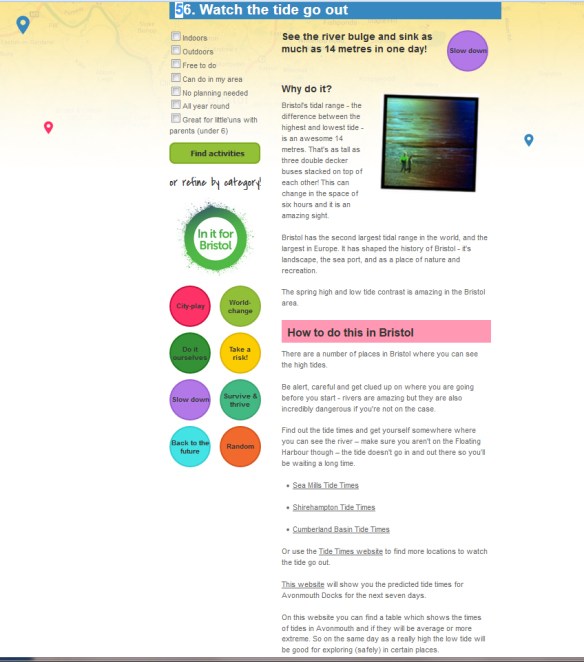
THis is a screen grab of Thing 56. 80×18 Things to Do in Bristol for Young People. See the Tide. See the website here
I came across these guys when visiting Lamplighters Marsh, Shirehampton, Bristol (Nr the mouth of the River Avon) They are members of Shirehampton Yacht Club, and, each Saturday, meet to clear mud of the old slipway. This used to be the slipway for Pill Ferry. Now it is used for launching the club’s boats. In the past the slipway was level with the bank and kept clear of mud by the flow of the tides. Now the banks have been built up on either side of the slipway (partly for flood defence) and each tide drops a lot of mud on it. It very quicky becomes unusable unless a rolling programme of clearing is maitained.


This is an interesting proposal
We are slightly wary of its seeming self-importance and feel of large corporate public art type stuff
Still – here is the info from the website
“Aluna is a unique proposal for the world’s first tidal powered Moon Clock. It will change the way we consider time and understand our planet.
Larger than Stonehenge, Aluna’s forty metre wide, five storey high structure is made up of three concentric translucent recycled glass rings.
By looking at how each ring is illuminated, you can follow the Moon’s movements, its current phase and the ebb and flow of the tides. This animation of light is called Alunatime.
Using the latest design and technologies, Alunatime will be powered directly by the tides using turbines.
A waterside landmark and a public sculpture, Aluna unites art, science and spirituality and is an ever-changing reminder of the natural cycles that have shaped our past”
Website here
Here is their promo film
Re-posted from
by Joanna Atherton
I am excited to announce that I will be exhibiting my flotsam tapestries in a new solo show at Artistsmeet in Rickmansworth, Hertfordshire. Time & Tide opens on 19 January and runs until 26 February 2016.

The sea curates orphaned objects and presents them to the shore; a temporary narrative replenished with each changing tide. I am fascinated by these unexpected and ignored fragments, imagining who they were important to in another time and place. By weaving strands of found objects together, I am able to repurpose the lost and rejected, pondering threads of stories and yarns long forgotten.

As well as your chance to see a unique collection of tapestries handwoven from materials found on the British coastline, you are invited to create your own small tapestry using coastline curiosities. Join me on Wednesday 27 January 2016 from 11am to view the exhibition and learn more about weaving with found objects. Looms, materials, coffee and cake provided – just bring your imagination!
Entry is free, but booking is required. To secure your place, please call 01923 776611 or email leisure@threerivers.gov.uk.
Download the Time & Tide exhibition flyer to book your place on a FREE 2 hour flotsam weaving workshop on Wednesday 27 January 2016 at the Gallery.
The Petitcodiac River and the Legend of the Tidal Bore Moncton, New Brunswick, Canada, by Michael Martin
see here
Sample picture

 Tidal Cultures