
Here I put a list of books about tides, estuaries and other tidal places.
The list currently numbers about 42 books.
They vary from the scientific histories to more arts and literature focused accounts. I have avoided highly technical books of tidal science. This is more about culture; as in “Tidal Cultures’. There are books about the natural history linked to tidal areas, and books about specific tidal places such as deltas, bays, sounds, stretches of coast, harbours, creeks, and, very often, estuaries.
See ‘Outputs’ pages for papers on tides by Owain and others.
I will start another page about tides in fiction soon.
I stress this is a selective, personal list. Most recent finds are added to the top of the list now (as of 2019).
Covers of the books, and links to them, are put where possible.
(Updated 30 12 2024)
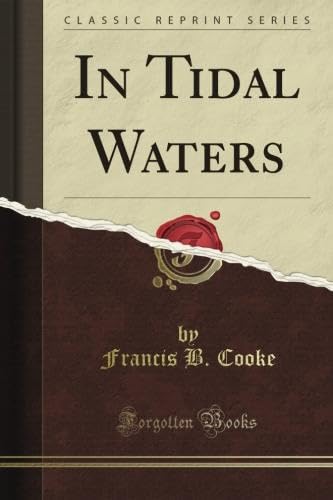
In Tidal Waters; Francis B. Cooke; 1919.
This is a book very much about sailing. Much of the account is of sailing around the coast of Eastern England including in the Thmes Estuary. The tides that had to be negotiated in various trips are very much to the fore in the narrative. A free pdf of this book is online here.
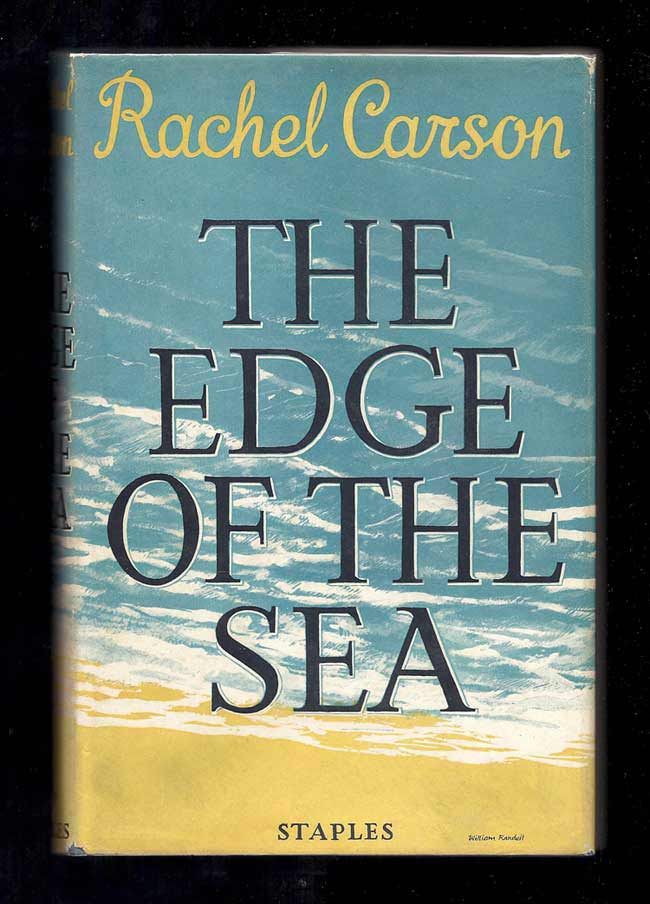
The Sea Trilogy by Rachel Carson. There are of course, many thousands of books about the sea. Many, even most, will discuss tides, either in passing or in more detail. It would not make sense, I feel, to list them here. But I do list Rachel’s Carson’s Sea Trilogy.
Perhaps it is not so well known that Rachel Carson, famous as the author the epoch defining Silent Spring published in 1962, launching, with much kick-back and professional and even personal jeopardy to her, the modern environmental movement, wrote, in the decades before, a trilogy of natural history books about the sea; Under The Sea Wind; The Edge of the Sea; and The Sea Around Us . She was an aquatic biologist, working for some time in the U.S. Bureau of Fisheries. Unsurprisingly, America’s long and varied coastline, their tides and inter-tidal zones feature heavily in all three books. Here is a quote from each book.
“The shore has a dual nature, changing with the swing of the tides, belonging now to the land, now to the sea. On the ebb tide it knows the harsh extremes of the land world, being exposed to heat and cold, to wind, to rain and drying sun. On the flood tide it is a water world, returning briefly to the relative stability of the open sea. [ ] Only the most hardy and adaptable can survive in a region so mutable, yet the area between the tide lines is crowded with plants and animals. In this difficult world of the shore, life displays its enormous toughness and vitality by occupying almost every conceivable niche.” (The Edge of The Sea, 1955).
More widely of the sea, she stated, in a famous quote at least in some quarters:
“There is no drop of water in the ocean, not even in the deepest parts of the abyss, that does not know and respond to the mysterious forces that create the tide. No other force that affects the sea is so strong.” (The Sea Around Us, 1951).

“As the night grew darker and the tides pressed farther into the marshes and moved higher into the estuary of the river, the silvery fish quickened their movements, feeling their way along the streams of less saline water that served them as paths to the river. The estuary was broad and sluggish, little more than an arm of the sound. Its shores were ragged with salt marsh, and far up along the winding course of the river the pulsating tides and the bitter tang of the water spoke of the sea.” (Under The Sea Wind, 1941)

All dates are fisrt publication dates.
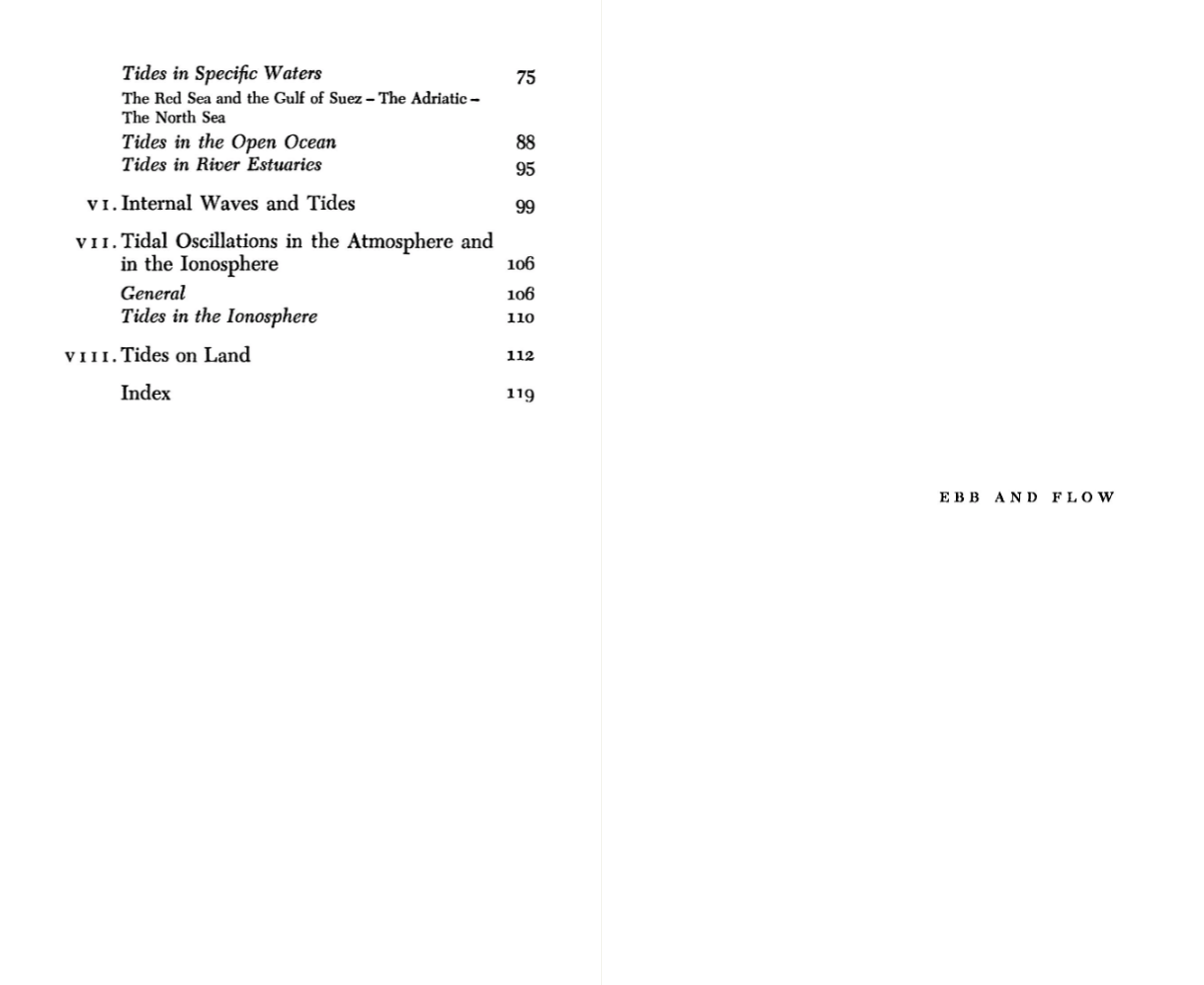
Ebb and Flow. The Tides of Earth, Air, and Water; Albert Defant; 1958.

Below are the title and content pages

The 7ERN BORE; Richard Tarr; 2023; (blog date)
“This work documents the surfing community of the Severn Bore a natural phenomenon which runs through the heart of Gloucestershire.”
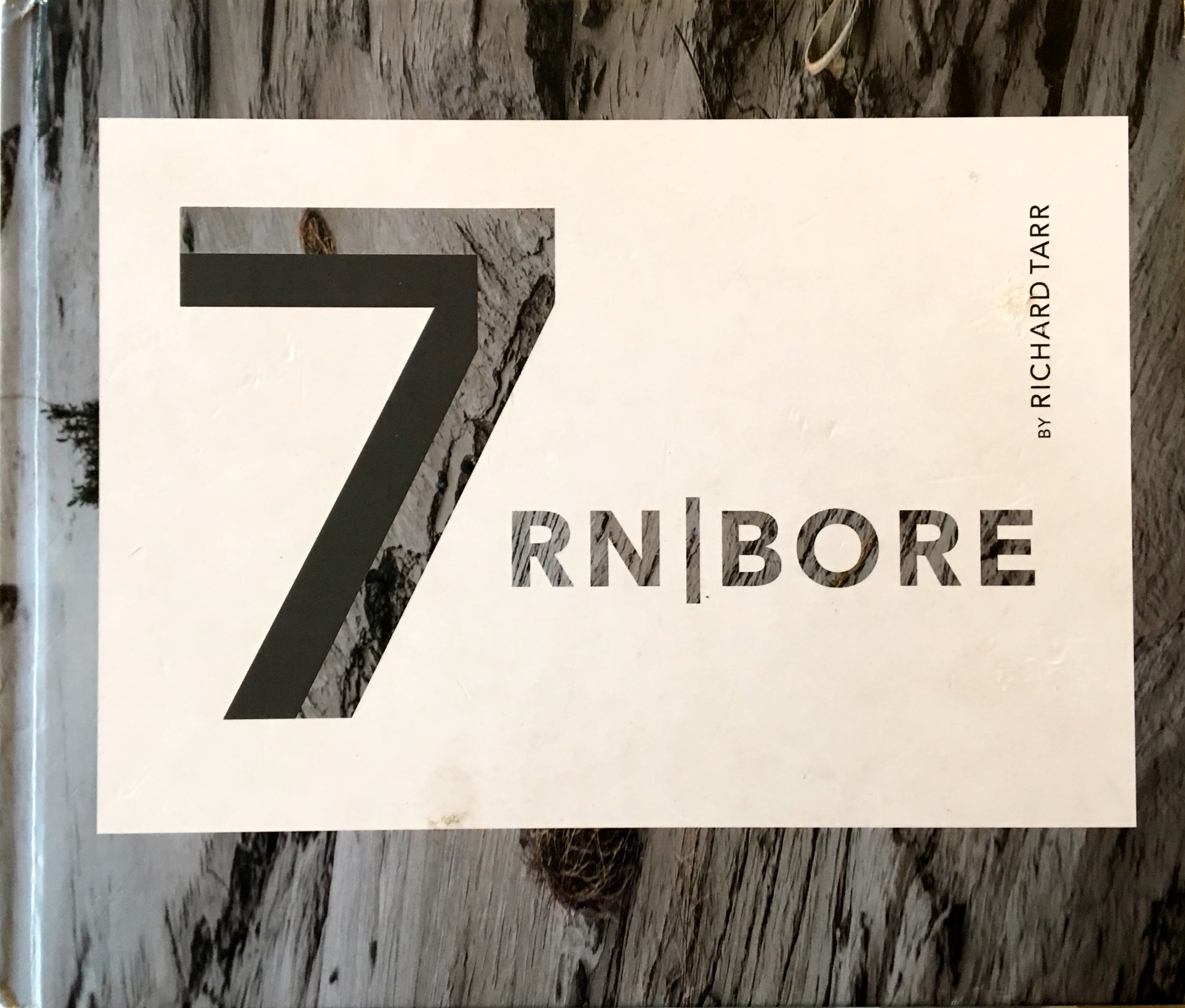
This is also an online blog by Richard so photos can be seen there.
Unravelling the Ripple; Helen Douglas; 2001
“A portrait of the tideline of a Hebridean island unfolds page-by-page, charting the physical, sensual and imaginative depths of the place where land and sea meet.”
The book is a series of photographs with no text. But there is a lovely introducing essay by the (rightly) famous Rebecca Solnit called ‘Seashell to the Ear’.
Thanks to my collaborator Heather Green for the gift of this book.
Click on image to go to Amazon.

The Tide; Harry Aaron Marmer; 1926.
Marmer was known for his extensive study of tides, and tides in different locations such as the Bay of Fundy and New York harbour.
Copies of this book can be seen online but not much about what is in it.
See about Marmer and his various publications on tides here. Wikipedia.
This book is cited in the next book below. That is how I heard of it.
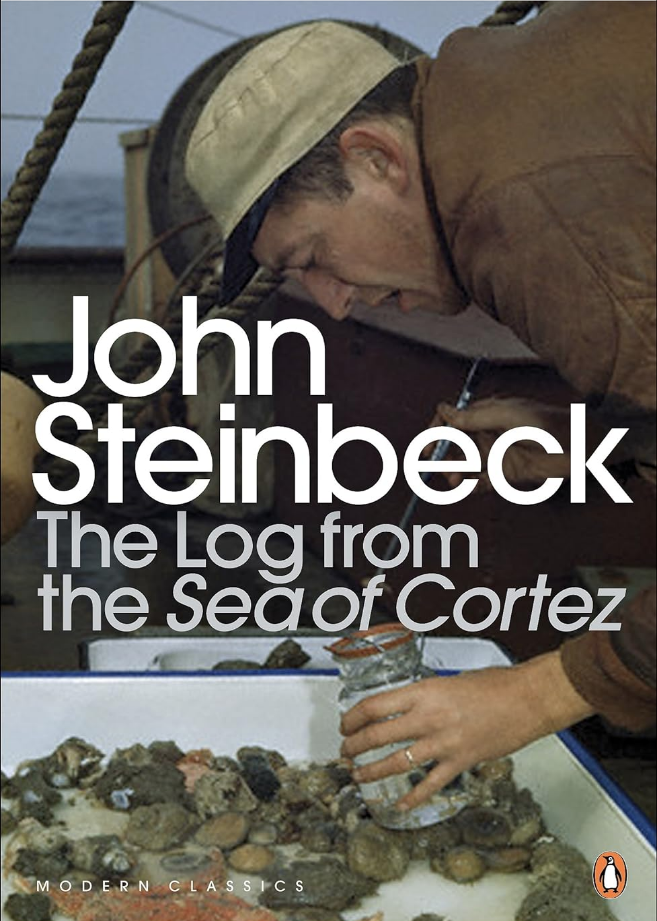
The Log from the Sea of Cortez; John Steinbeck; 1951.
From Wikipedia here
“The Log from the Sea of Cortez is an English-language book written by American author John Steinbeck and published in 1951. It details a six-week (March 11 – April 20) marine specimen-collecting boat expedition he made in 1940 at various sites in the Gulf of California (also known as the Sea of Cortez), with his friend, the marine biologist Ed Ricketts. It is regarded as one of Steinbeck’s most important works of non-fiction chiefly because of the involvement of Ricketts, who shaped Steinbeck’s thinking and provided the prototype for many of the pivotal characters in his fiction, and the insights it gives into the philosophies of the two men.
The Log from the Sea of Cortez is the narrative portion of an earlier work, Sea of Cortez: A Leisurely Journal of Travel and Research, which was published by Steinbeck and Ricketts shortly after their return from the Gulf of California, and combined the journals of the collecting expedition, reworked by Steinbeck, with Ricketts’ species catalogue. After Ricketts’ death in 1948, Steinbeck dropped the species catalogue from the earlier work and republished it with a eulogy to his friend added as a foreword.”
This is included here because the Sea of Cortez, (Gulf of California), is highly tidal. A lot of the marine specimens collected on the trip were from intertidal areas and the coastal margins. The state of the tide features frequently in the narrative.
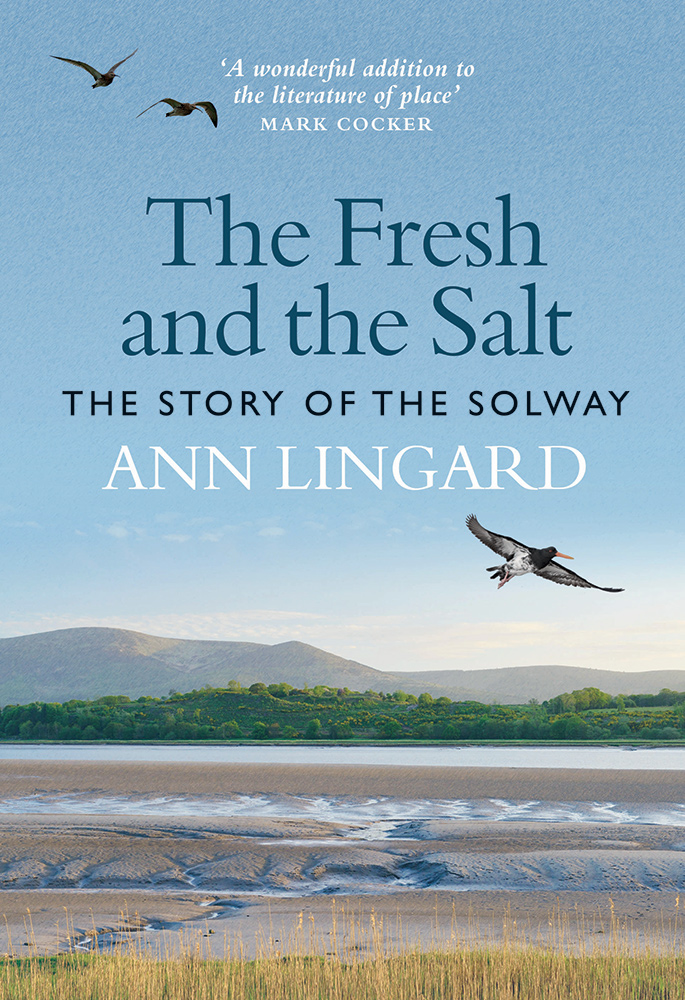
The Fresh and the Salt. The Story of the Solway; Ann Lingard; 2020; Birlinn Books.
“Firths and estuaries are liminal places, where land meets sea and tides meet freshwater. Their unique ecosystems support a huge range of marine and other wildlife: human activity too is profoundly influenced by their waters and shores.
The Solway Firth – the crooked finger of water that both unites and divides Scotland and England – is a beautiful yet unpredictable place and one of the least-industrialised natural large estuaries in Europe. Its history, geology and turbulent character have long affected the way its inhabitants, both human and non-human, have learnt to live along and within its ever-changing margins.” Source; Amazon click image to go there.
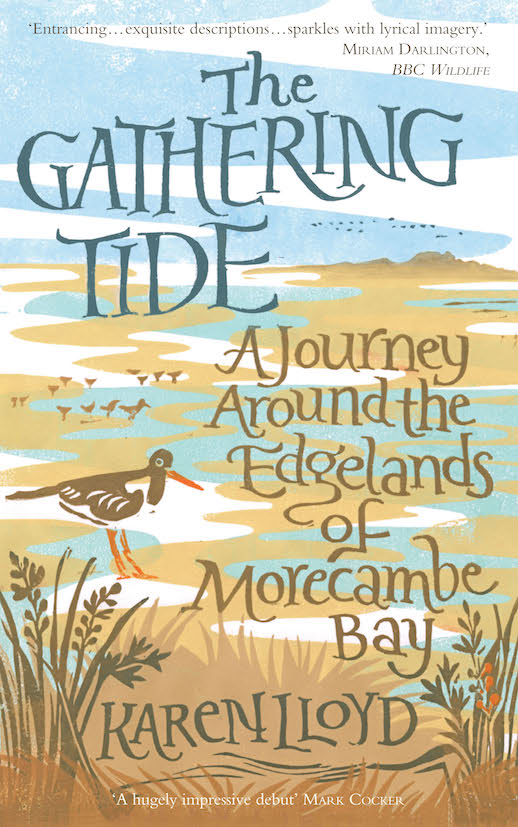
The Gathering Tide: Around the Edgelands of Morecambe; Karen Lloyd; 2016; Saraband Books.
The Book of Tides: A Journey Through the Coastal Waters of our Islands; William Thompson; 2016.

Click Image to go to Amazon.
Amazon Summary
“An idiosyncratic, richly illustrated guide to Britain’s rivers, seas and shores, for everyone who loves the water and the natural world – a Norwegian Wood for Britain’s waters
This is a book for those who want to understand better how the waters surrounding us affect our daily lives, how it imperceptibly but crucially shapes our actions, and has shaped our landscape for millenia. It’s for anyone who knows and loves our coast, and who wants to understand, discover, surf, or sail it better.
Inspired by his own witnessing of the power of the sea through travelling around Britain’s coastline in a panel van with his young family, William Thomson tells the story of the cycles of the sea. He combines a lyrical, passionate narrative with graphically beautiful renderings of the main forms of water which affect Britain: Rip, Rapids, Swell, Stream, Tide, Wave, Whirlpool, Tsunami.
The Book of Tides is a book for all of us who feel the pull of the sea and the tug of the tide.” (Amazon)
The Sea is Not Made of Water: Life Between the Tides; Adam Nicolson, William Collins; 2021.
“-Few places are as familiar as the shore – and few as full of mystery and surprise.
How do sandhoppers inherit an inbuilt compass from their parents? How do crabs understand the tides? How can the death of one winkle guarantee the lives of its companions? What does a prawn know?
In The Sea is Not Made of Water, Adam Nicolson explores the natural wonders of the intertidal and our long human relationship with it. The physics of the seas, the biology of anemone and limpet, the long history of the earth, and the stories we tell of those who have lived here: all interconnect in this zone where the philosopher, scientist and poet can meet and find meaning.
In this blend of fascinating, surprising ecology and luminous human history, Adam Nicolson gives an invitation to the shoreline. Anyone who chooses can look beyond their own reflection and find the marvellous there, waiting an inch beneath their nose.” (From Amazon. Picture below will link to Amazon.
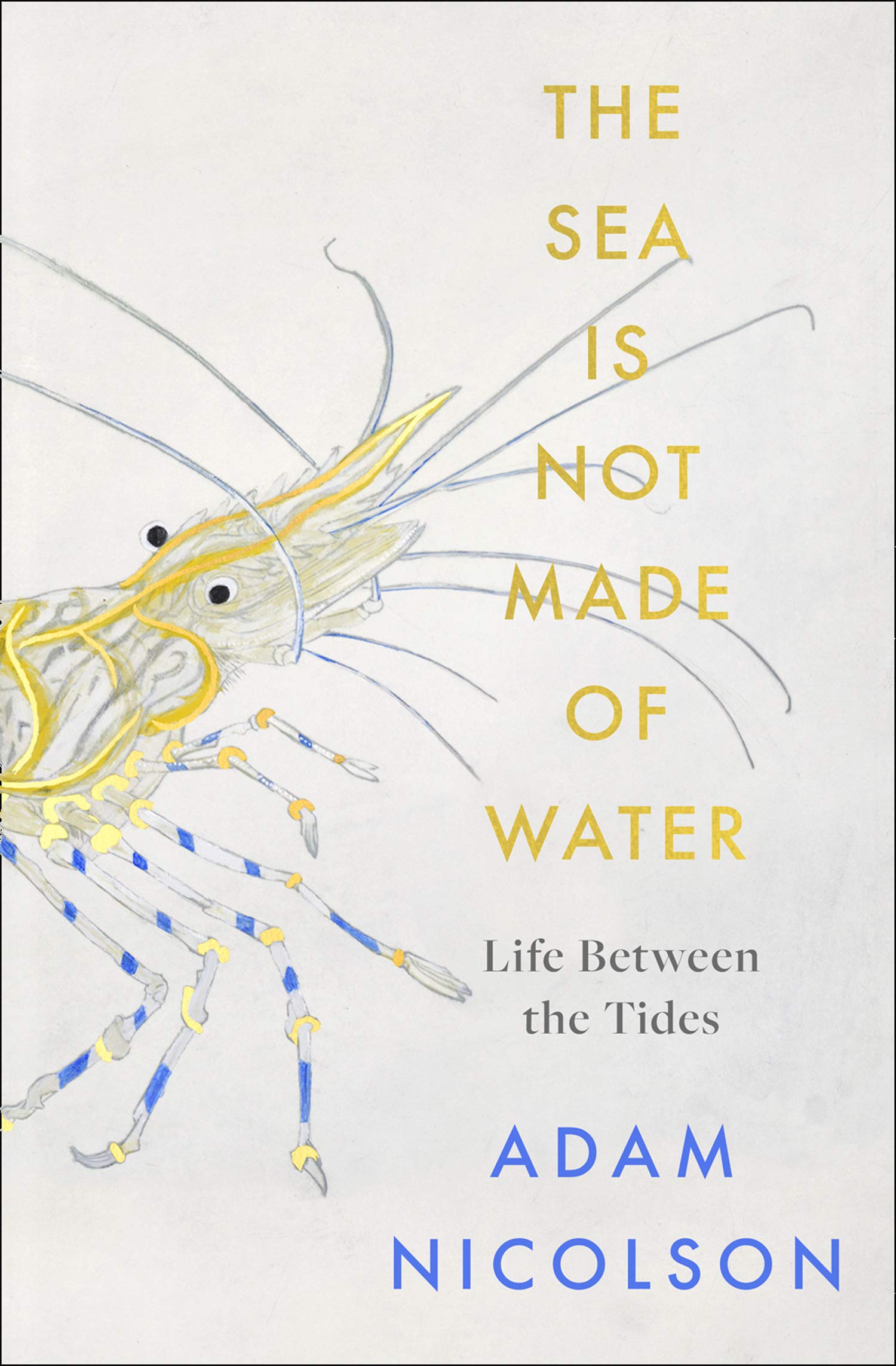
This book now re-publsiehd as below in 2022.

Click image to go to Amazon and ‘look inside’.
Edging the Estuary; Peter Finch; Seren Books 2013.
In the Middle Ages the port of Cardiff stretched from Chepstow to Gower. Peter Finch, archetypal Cardiffian, sets out to explore his heritage, walking the Welsh side of the Severn Estuary and reclaiming his personal memories in addition to discovering the lives of others. And with a detour to Maismore, the highest tidal point of the estuary, he walks the English side too, taking in the differences with Wales, reviving past links and looking at his homeland from abroad.
On his journey he sees the estuary as border, a highway for trade and ideas, an industrial zone, and a place where people spend their leisure. Rich in anecdote, evocative in description, Finch s book takes in villages and cities, power stations and fishermen, castles and caravans, leg-aching walks and deckchairs on the beach. The tragedy of Lynmouth, the competing delights of Porthcawl, Barry and Weston-super-Mare, the industrial sites of Usk and Port Talbot, the fate of Cardiff, Newport and Swansea docks, the ancient trackways of Swansea Bay and the Star Inn at Neath are just some of the many stories which punctuate Finch s epic walk along some of the most beautiful coastline in Britain. (Amazon)
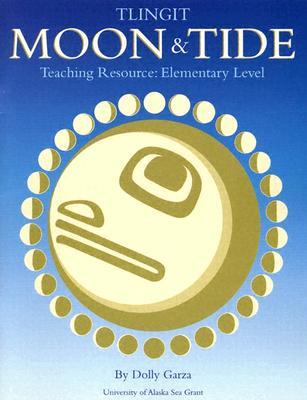
Tlingit Moon and Tide Teaching Resource: Elementary Level: Dolly Garza; 1999.
As it name suggests, this is a teaching resource at elementary level for The Tlingit community. The Tlingit are indigenous peoples of the Pacific Northwest Coast of North America. See here in Wikipedia. It contains information of how to teach the moon phases and also local culture, traditions and histories to the new generations of the community, and also the science of tides and the moon. Also about how the community have traditionally passed on knowledge via elders and so on. There is plenty of lovely information in it. Chapter 2 is called “The Moon in Tlingit Culture”; Chapter 3 is called; People of the Tide; and begins:
“Reflecting the tie between people and the sea, Cyrus E. Peck Sr. explains that the word Tlingit, commonly defined as “the people,” really means “the Tides People” because Tlin (pronounced lein) means tides in Tlingit and git is Tsimshian for human being (Peck 1975).
Hard copies and a PDF of this book (at very modest prices) are available here
Tides. A Very Short Introduction; David George Bowers and Emyr Martyn Roberts; 2019; Oxford Univeristy Press.
Thanks to David George Bowers for info
Picture is link to Amazon

Details off Amazon
“The tide is the greatest synchronised movement of matter on our planet. Every drop of seawater takes part in tidal motion, driven by the gravitational pull of the moon and sun. At the coast, we see the tide as a twice-daily rise and fall of sea level that moves the edge of the sea up and down a beach or cliff-face. In some places, the tide is small but at others it can rise in a few hours by the height of a three storey building; it then has to be treated with great respect by those who live and work by the sea.
In this Very Short Introduction David George Bowers and Emyr Martyn Roberts explore what we know about the tides. Blending clear explanations of well known tidal phenomena with recent insights in the deep ocean and coastal seas, Bowers and Roberts use examples from around the world, to tell the story of the tide, considering its nature and causes, its observation and prediction, and unusual tides and their relevance. They explore why tides have attracted the attention of some of the world’s greatest scientists, from the initial challenge of explaining why there are two tides a day when the moon and sun pass overhead just once; a problem that was solved by Isaac Newton. In the 19th century, scientists unravelled the rhythms of the tide; good tidal predictions in the form of tide tables were then possible. The predictions were made on beautiful tide predicting machines constructed of brass and mahogany, some of which can still be seen in maritime museums. In the 20th century, the importance of tides as mixers of sea water became evident. As Bowers and Roberts explore, tidal mixing of the ocean is essential for maintaining its deep circulation, a key part of the climate-control system of our planet. In inshore waters, tidal mixing enhances biological productivity, influences sea temperature and turbidity and creates dramatic features such as maelstroms and tidal bores. In the 21st century, space probes are examining the effects of tidal processes on the moons of Jupiter and Saturn and the possibility of tidally-heated liquid oceans with their own ecosystems. Looking to the cutting edge of tidal research, Bowers and Roberts also consider how we can study the role of the tide in the geological and biological evolution of our own planet with innovative computer models.”
Shallow Water Dictionary: A Grounding in Estuary English, by
“Shallow Water Dictionary is both a celebration of the richness of our vernacular language and a lament on its passing and with it, the passing of the words we need to understand our shallow water regions, once the primary landscape of America and now facing extinction, both physical and linguistic. This small book is an intriguing and valuable addition to our knowledge of a changing landscape. Literary, etymological, historical, and vernacular investigations of such varied terms as guzzle, creek, and chartreuse, Stilgoes definitions are lyric explanations of words whose original meanings have been eroded by time.”
There have been various editions of this – some are quite rare – and expensive!
Here is the cover of a newer, illustrated edition.
Thanks to Heather Green for info

Between Stony Brook Harbor Tides: The Natural History of a Long Island Pocket Bay; by R. Lawrence Swanson and Malcolm J. Bowm; Excelsior Editions; 2016.
“Stony Brook Harbor, or Three Sisters Harbor as it was known historically, is perhaps the most pristine of the Long Island north shore pocket bays. Untouched by major commercialization, it has been designated a Significant Coastal Fish and Wildlife Habitat by the New York State Department of State and a Significant Coastal Habitat by the US Fish and Wildlife Service. Despite these designations, however, there is constant pressure to increase development of and around the harbor.
Between Stony Brook Harbor Tides interweaves scientific understandings of the harbor with a consideration of its colorful history to inform and educate a general audience about its unique and delicate state. Data is used to illustrate the harbor’s tides and currents and to show how they influence geological processes and pollution susceptibility. Storm surge measurements going back to the early 1990s document some of the extreme high waters experienced, and descriptions of some of the more interesting or important marine species of plants and animals found in the harbor are also included. The book discusses the century-long conflicts that local residents have fought in order to preserve this beautiful place, and it documents the tools that currently exist to help manage the harbor well into the twenty-first century. An excellent supplement to any high school or undergraduate environmental course, Between Stony Brook Harbor Tides provides readers with a basis for embracing the significance of the harbor and what it can bring to future residents.” (Amazon. Click on image below to ‘Look Inside’.

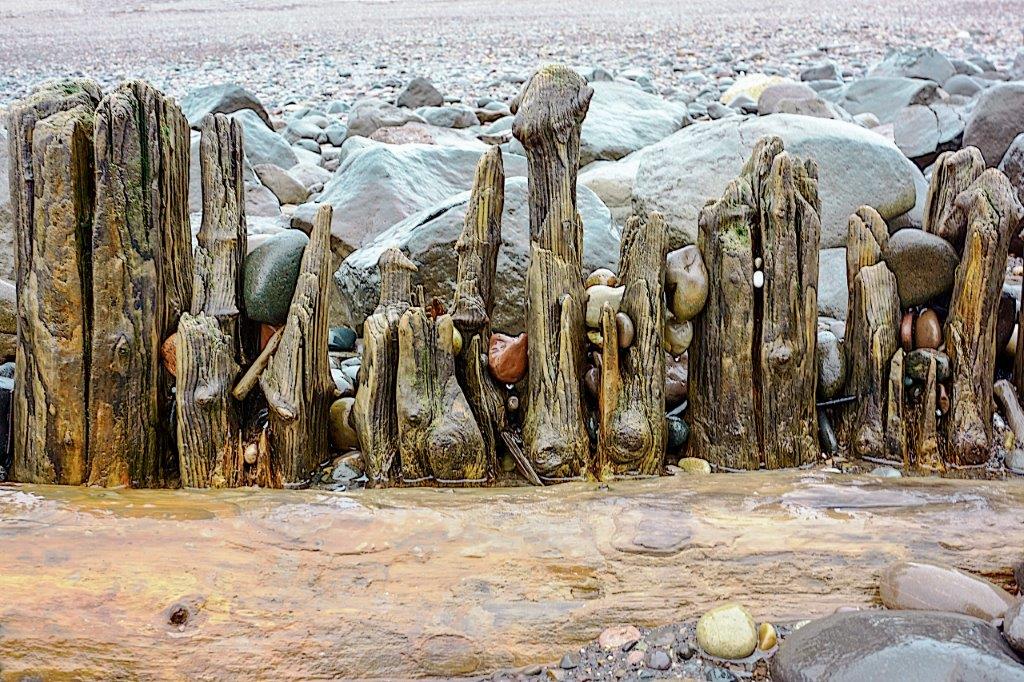
Between Tides: Ronald C. Webber (2019?).
Available from the book website here
“A natural and unique phenomenon: the artist’s documentation of a Nova Scotia 19th century wharf remnants that have been shaped by the Bay of Fundy’s world highest tides for over a century
Author Bio: Ron is a photographer artist living in Nova Scotia. He studied fine arts in Halifax and Montreal. Exhibited across Canada highlighted by a solo exhibition at Le Salon of the National Arts Centre in Ottawa. He was honored with a Canada Council Grant in photography and was nominated in Landscape Seascape categories at the Fine Art Photography Awards in London. A selection of his work is in the Canadian Museum of Contemporary Photography in Ottawa. He authored his first book “Peggys Cove Mist & Rocks” a visual essay on the historic fishing village. Ron is a modern Renaissance artist having worked in the traditional arts, film, animation and photography.”
Thanks to the author for reaching out to this blog and the image.
Three books about Mudlarking (searching for objects of interest and value at low tide in river/harbour mud) on the Thames River are listed elsewhere on this site – here
Tides: The Science and Spirit of the Ocean; Jonathan White; 2018; Trinity University Press
“In Tides: The Science and Spirit of the Ocean, writer, sailor, and surfer Jonathan White takes readers across the globe to discover the science and spirit of ocean tides. In the Arctic, White shimmies under the ice with an Inuit elder to hunt for mussels in the dark cavities left behind at low tide; in China, he races the Silver Dragon, a twenty-five-foot tidal bore that crashes eighty miles up the Qiantang River; in France, he interviews the monks that live in the tide-wrapped monastery of Mont Saint-Michel; in Chile and Scotland, he investigates the growth of tidal power generation; and in Panama and Venice, he delves into how the threat of sea level rise is changing human culture the very old and very new. Tides combines lyrical prose, colorful adventure travel, and provocative scientific inquiry into the elemental, mysterious paradox that keeps our planet’s waters in constant motion. Photographs, scientific figures, line drawings, and sixteen color photos dramatically illustrate this engaging, expert tour of the tides.” (Amazon)

This looks great – here is a quote
The tideslands – the lands exposed by low tide and covered by high tide – have a unique role in the region’s legal, economic, and social history (p 2).

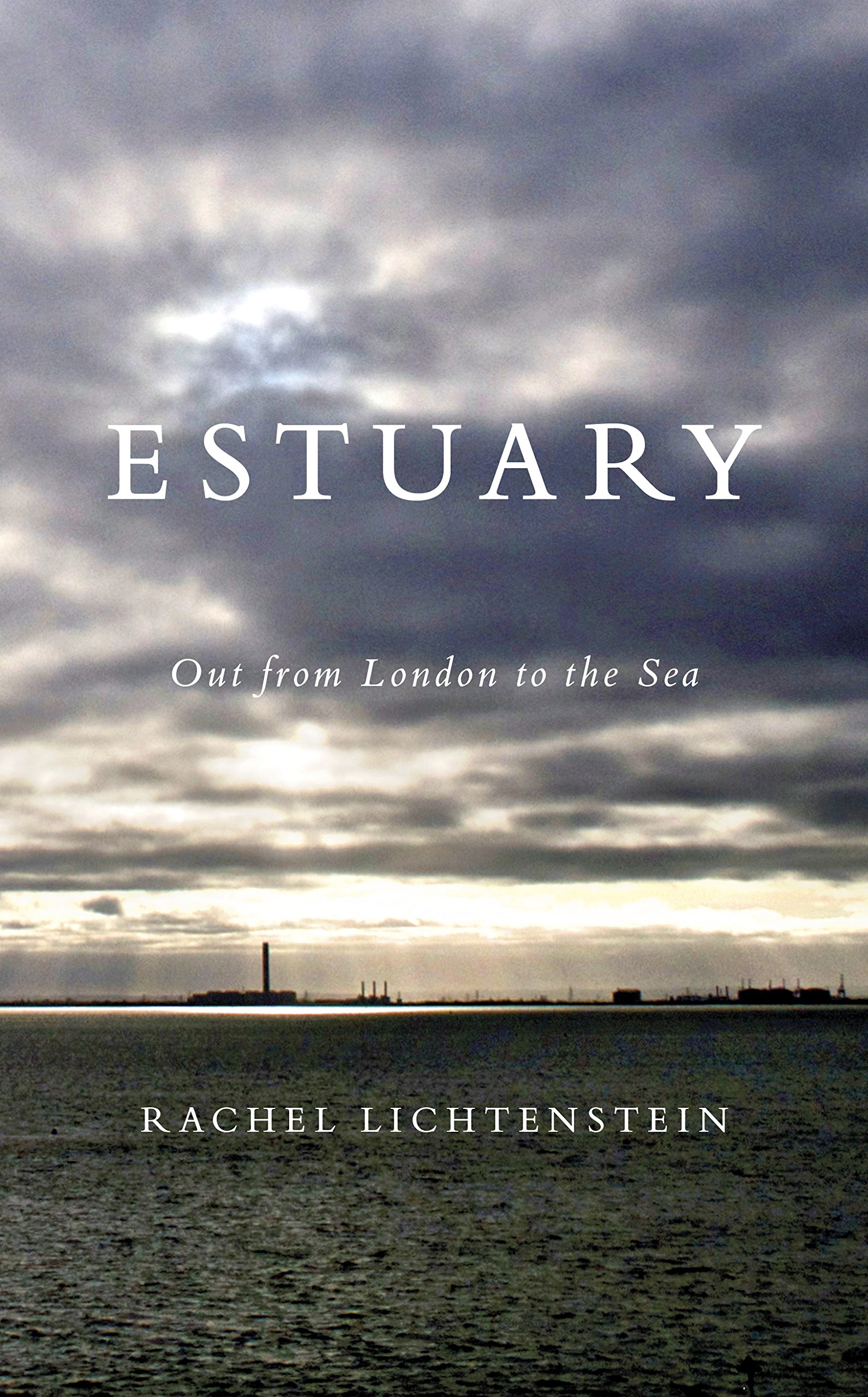
Estuary: Out from London to the Sea; 2016
An immersive, intimate journey into the world of the Thames Estuary and the people who spend their lives there
The Thames Estuary is one of the world’s great deltas, providing passage in and out of London for millennia. It is silted up with the memories and artefacts of past voyages. It is the habitat for an astonishing range of wildlife. And for the people who live and work on the estuary, it is a way of life unlike any other – one most would not trade for anything, despites its dangers.
Rachel Lichtenstein has travelled the length and breadth of the estuary many times and in many vessels, from hardy tug boats to stately pleasure cruisers to an inflatable dinghy. And during these crossing she has gathered an extraordinary chorus of voices: mudlarkers and fishermen, radio pirates and champion racers, the men who risk their lives out on the water and the women who wait on the shore.
From the acclaimed author of Brick Lane and Rodinsky’s Room, Estuary is a thoughtful and intimate portrait of a profoundly British place. With a clear eye and a sharp ear, Rachel Lichtenstein captures the essence of a community and an environment, examining how each has shaped and continues to shape the other. Source here
Tide: The Science and Lore of the Greatest Force on Earth; Hugh Aldersey-Williams
2016; Viking Books.
“From Cnut to D-Day: the history and science of the unceasing tide explored for the first time.
Half of the world’s population lives in coastal regions lapped by tidal waters. Yet how little most of us know about the tide.
Our ability to predict and understand the tide depends on centuries of science, from the observations of Aristotle and the theories of Newton to today’s supercomputer calculations. This story is punctuated here by notable tidal episodes in history, from Caesar’s thwarted invasion of Britain to the catastrophic flooding of Venice, and interwoven with a rich folklore that continues to inspire art and literature today.
With Aldersey-Williams as our guide to the most feared and celebrated tidal features on the planet, from the original maelstrøm in Scandinavia to the world’s highest tides in Nova Scotia to the crumbling coast of East Anglia, the importance of the tide, and the way it has shaped – and will continue to shape – our civilization, becomes startlingly clear.”

Book image is link to more info.
Tides are a “mysterious physical phenomena.”
There is something “rather curious and unaddressed about our understanding of the tides.”
Quotes from this Guardian Book Interview with the author by Patrick Barkham
On the History of Tidal Science:
Tides: A Scientific History 2000)
 (image is link to Amazon UK)
Dynamics of Ocean Tides; G. I. Marchuk, B. A. Kagan; 1989; Springer Books.
This is a highly technical book about experimental measurements of tidal forces in the oceans. Much of it is based upon complex mathematical formulas. Measurements by satellite and tide stations are sources of data. It talks about the varying tidal patterns in the differing oceans (and the degreee to which some are still unknown). Quite a lot of the book is visible on Google Books here
A ‘common sense’ approach to understanding tides.
Beyond the Moon: A Conversational, Common Sense Guide to Understanding the Tides.
“Beyond the Moon” describes how the cyclical motion of the near solar system is impressed upon the earth’s oceans, and how the hydraulics over the continental shelf and the geography of the coastline orchestrate this rhythm into the bewildering variety of tide patterns seen around the globe. This volume demystifies the complexity of the tides by systematically examining its many constituents and demonstrates that: “Nature is, at once, awesome in complexity and beautiful in simplicity.”
Source of above and more info here
Tides: Pulse of the Earth; Edward P. Clancy;1968; Doubleday.
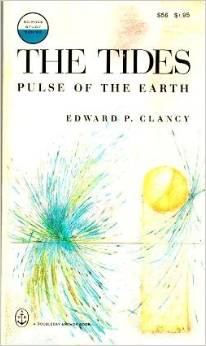
There is little or no info about, or content of, this book on the web as far as i can see.
The Tides; Christian Knowledge Society, 1857.
Most of this book is online here (inc., on occasions, the hand of whoever was doing the copying!)
It is very interesting in trying to give a relatively simplified, but mathematically informed account of why ides happen. Snooker balls are a preferred analogy.
The tides in the various oceans are described, and tide and trade discussed
There is a section on The Tides of the British Seas and Tides and Rivers , and the Improvements of Tidal Rivers. (This was the Victorian age!)
On tides and life on earth
Ebb and Flow: Tides and Life on Our Once and Future Planet; Tom Koppel; 2007; Dundurn Group.
 Image is link to Amazon UK
“This fascinating book shows us how the understanding of tidal movement has been crucial to human existence on planet Earth. Drawing on history, science and personal memories, he demonstrates that a subject we take for granted affects all our lives. The author weaves together three grand narratives exploring how tides have affected the physical shape of the land, how they have affected human history and development, and how science has worked to understand the surprisingly complex way in which they actually work.”
Great book about UK Tidal Islands
No Boat Required: Exploring Tidal Islands; Peter Caton; 2011; Peter Caton.
“When is an island not an island? Peter Caton takes us to all four corners of England, Scotland and Wales to find out. Sharing our nation’s fascination with islands, Peter sets out to be the first person to visit all 43 tidal islands which can be walked to from the UK mainland. Along the way he faces many challenges: precipitous cliffs, vicious dogs, disappearing footpaths, lost bus drivers, fast tides, quicksand and enormous quantities of mud, but also experiences wonderfully scenic journeys by road, rail and on foot. He contrasts the friendly welcome from most islanders and owners with the reluctance of others to permit visits, and tells how he was thrown off one secret island. An entertaining narrative illustrated with colour photographs, No Boat Required contains a wealth of information as the author unearths many little known facts and stories. It tells of the solitude of the many remote islands and the difficulties of balancing the needs of people and wildlife. We learn of the islands’ varied histories – stories of pirates, smugglers, murder and ghosts, of battles with Vikings, an island claimed by punks and another with its own king. He writes of the beauty of the islands and our coast, and reflects on how these may be affected by climate change. In No Boat Required Peter Caton takes us to explore islands, some familiar but most which few of us know exist and even fewer have visited. He finds that our tidal islands are special places, many with fascinating and amusing stories and each one of them different. It adds up to a unique journey around Britain.”
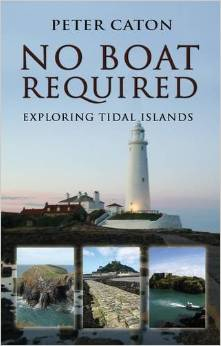
Image is link to Amazon.co.uk
Very lovely photograhic essay which conisites of identical pairs of photos – one at low tide – one at high tide
Sea Change; Michael Marten; 2012; Kehrer Books.
“Since 2003 Michael Marten has travelled to different parts of the British coast to photograph identical views at high and low tide, six or eighteen hours apart. His beautiful and surprising photographs reveal how landscapes can be dramatically transformed by natural phenomena such as tides. From rocky shores to summer beaches and industrial estuaries, these images record two moments in time, two states of nature and show landscape to be a dynamic process. Sea Change present 53 of these diptychs, arranged as a clockwise journey around Britain.”

Picture is link to amazon.co.uk
Tidal Life. A Natural Hostory of the Bsay of Fundy; Harry Thurston with Photographs by Stephen Homer; 1990; Camden House.
“Tidal Life is the definitive natural and human history of the unique and massive Bay of Fundy. With visual reminders of the Bay’s immensity and impact. Winner of the Evelyn Richardson Award for non fiction, the Dartmouth Book Award for non-fiction and the Atlantic Provinces Booksellers Choice Award.” Amazon.com
Extract from a review by Ronnie Scullion
“It is in the hopes of protecting and preserving this vital and dynamic ecosystem that gave impetus to writing this book. Thurston shares with us his many insights into the bay’s natural wonders what accounts for the dramatic rise and fall of the tides, the largest in the world; the geological formation of the spectacular coastline; and the varied and rich life that flourishes in this unusual ecosystem from the single-celled phytoplankton to the fish, birds and mammals that populate its waters and shore.
The “people” of the bay are also introduced: the fisherman and village folk, who as their ancestors before them rely on the bay for their livelihood; and the scientists and naturalists, who are drawn to the bay because of its scientific uniqueness and inspiring beauty. By contrast he also examines the imminent dangers of exploitation of the bay’s natural resources.
Overfishing and pollution has already rendered some species of plants and animals endangered or extinct. Threats of development continue to pose a hazard.”
Between the Tides. The Perilous Beauty of Morecambe Bay; Cedric Robinson; 2007; Great Northern Books.
Cedric Robinson was ‘The Queen’s Guide to the Sands’, the officical guide to how to explore this huge and potetially very dangerous place.
From a review by Jenny Laue
“Between the Tides looks at the dangers of the shifting sands, historical events and tragedies, birds, fish, people, fishing and farming, cockle picking and leisure activities taking place across the wide expanse.
The bay has many faces and Robinson has taken time to lay them bare, not just its fragile beauty but also the dangers lurking beneath the sands. In one memorable chapter, Death on the Sands, he recounts the tragic events and fatalities recorded, including the most recent which made international headlines, when, in 2004, 22 Chinese cockle pickers lost their lives in the fast-rising tide.
He looks at the lives of the fisherfolk who have worked the sands for centuries and also recalls the numerous well known figures who have crossed the bay with him, including the Duke of Edinburgh (who provided the foreword to this book), Melvyn Bragg, Bill Bryson, Harry Secombe, Judith Chalmers, Victoria Wood and many others. He shows us the wildlife that lives in this dramatic environment and discusses the apparent consequences of global warming as dolphins and salmon become a regular sight in the bay.
The book is beautifully illustrated with photographs that depict both the walk and the vast expanse of Morecambe Bay in all its amazing variety.”
Full Moon Flood Tide. Bill Proctor’s Raincoast; Bill Proctor and Yvonne Maximchuk; 2003 & 7; Harbour Publishing.
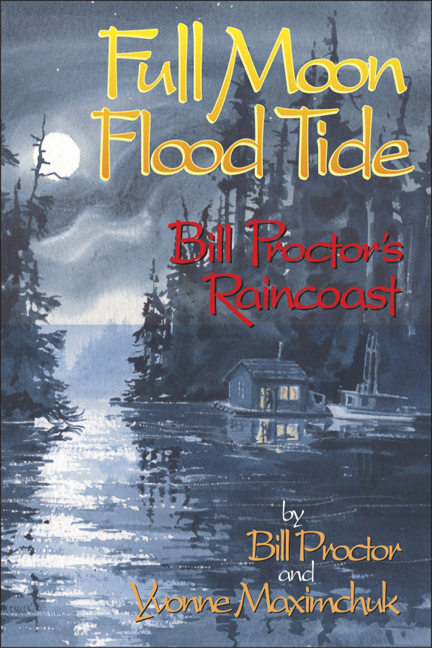
“The big flood tide that accompanies the full moon is a pivotal event for those who make a living from the sea. Salmon returning to their natal rivers and streams always come in on the full moon tide, so this is the best time for fishing. And since the full moon ebb tide retreats farther than usual, it’s also the best time to gather shellfish.
Bill Proctor has lived and worked by the full moon flood tides for all his life. A natural storyteller, he points the way to hidden waterfalls and abandoned Native village sites, knows the best coves for shelter in a sou’easter and shares the compelling and often funny stories of the Natives and settlers who loved this place. People like Fritz Salem, who made the best moonshine on the coast; Joe Jack, who knew the secrets of fishing for spring salmon in winter; and Dad McKay, who lived on eggs and bannock in a hollow cedar stump. Some of Proctor’s stories will raise goosebumps around a campfire–like the sad fate of the Maid of Orleans, a former slave ship, or strange encounters with a giant sleeper shark and the ghost of Kingcome Inlet.
Full Moon, Flood Tide is no conventional cruising guide, but an indispensable companion for travellers around northern Vancouver Island, Fife Sound, Wells Passage, Blackfish Sound and Tribune Channel. Maps illustrate the places Proctor describes, in an order suitable for visiting by boat. Brimming with coastal lore and sprinkled liberally with Yvonne Maximchuk’s line drawings, this fascinating volume pays tribute to pioneers who wrested a livelihood from forest and sea even as it makes a passionate plea to preserve the wilderness.” Source
This is a set of stories and personal reminiscences about sailing – but as the sailing is often on the tidal Maine coast, the tides are a key feature of the book.
Spring Tides; Samuel Elliot Morison; 1965; Houghton Mifflin Company
“The sea belongs to all of us.” (viii)
“Spring tides are beloved by all who live by or from the sea.” (2)
Tidal Thames: History of a River and Its Fishes; Alwyne Wheeler; 1979; Routledge & Kegan Paul Books.
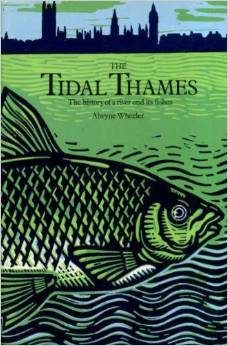
This is all about the aquatic life of the tidal Thames. For once it is quite an encouraging story.
“much of the [tidal] river was until quite recently lifeless as a result of gross pollution, and is now [1979] inhabited by a rich fauna of invertebrates and fishes.”
There are chapters on this recovery and on ‘migratory and estuarine fishes’ – with lovely illustrations
The Intertidal Wilderness: A Photographic Journey Through Pacific Coast Tidepools; Anne W Wertheim; 2002; University of California Press.
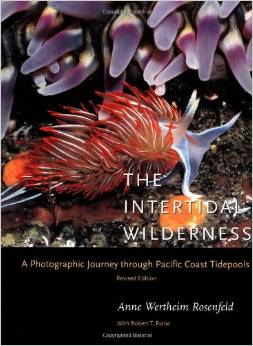
“The Intertidal Wilderness is a stunning photographic exploration of the tidepools of the Pacific coast, from Baja California to as far north as southeast Alaska. These lush photographs capture in striking color the enormous variety of life and biological detail in the intertidal zone along one of the world’s most spectacular coastlines. The interpretative text and captions describe telltale signs of ecological relationships and processes, helping the seashore explorer to appreciate ecological interactions and their consequences. The text delves into the roles of competition, predation, reproduction, natural variation in space and time, and color that characterize this vibrant ecosystem. This revised edition has been updated throughout, incorporating new scientific information, new photographs, and a new chapter discussing the recent human impact on this threatened environment. Fusing art and science, The Intertidal Wilderness conveys the fragility, complexity, and interdependence of the plants and animals living at the interface of land and sea. The Intertidal Wilderness vividly animates the surprisingly delicate beauty of the often violent intertidal zone, which daily withstands pounding waves at high tides as well as desiccation and exposure at low tides. With revealing photographs, engaging text, and a solid foundation in marine biology, this book will capture the imagination of the casual seashore visitor as well as the dedicated enthusiast.” Souce and more info here.
Strands: A Year of Discoveries on the Beach; Jean Sprackland; 2012; Jonathan Cape.
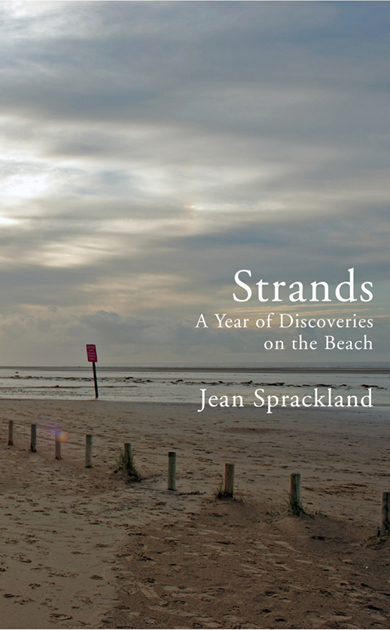
“This is the ultimate beachcomber’s book. A series of meditations prompted by walking on the wild estuarial beaches of Ainsdale Sands between Blackpool and Liverpool, Strands is about what is lost and buried then discovered, about all the things you find on a beach, dead or alive, about flotsam and jetsam, about mutability and transformation – about sea-change.
Every so often the sands shift enough to reveal great mysteries: the Star of Hope, wrecked on Mad Wharf in 1883 and usually just visible as a few wooden stumps, is suddenly raised one day, up from the depths – an entire wreck, black and barnacled, and on either side two more ruined ships, taking the air for a while before sinking back under the sand.
And stranger still, perhaps, are the prehistoric footprints of humans, animals and birds on the beach: prints from the Late Mesolithic to mid-Neolithic period which are described as ‘ephemeral archaeology’ because they are preserved in the Holocene sediment, revealed briefly and then destroyed by the next tide.
Strands describes a year’s worth of walking on the ultimate beach: inter-tidal and constantly turning up revelations: mermaid’s purses, lugworms, sea potatoes, messages in bottles, buried cars, beached whales and a perfect cup from a Cunard liner. Jean Sprackland, a prize-winning poet and natural storyteller, is the perfect guide to these shifting sands – this place of transformation.” Source and more info here.
Review of book here
TideLine; Edward Seago; 1948; Collins.
This is a sort of memoir by the painter Edward Seago. According to Rockethouse (small production company founded by Matt Thompson)
Seago “loved the sea and the sky and where the two met the land. He lived and painted mainly in East Anglia but also travelled to Singapore, Africa and, with the Duke of Edinburgh, Antarctica. His shows were so popular that the public would queue around the block. But he was not admired by art critics. He was a post-impressionist at a time when the fashion was for cubism, abstract expressionism, and all the other -isms. Seago was left in the dust, or in his case in the sands and mud of Norfolk. The tide goes out but eventually it comes in again and his art is still much loved and admired.
Over the years I returned again and again to Tideline to smell the sea air of estuarine places and to reacquaint myself with characters such as Mrs Chubbs and her garden or ‘Scientific’ who lived in a eel hut on the reed beds of the Norfolk Broads.” Source
Soundings from the Estuary; Frank Watson; 2014; Thames Estuary. Hush House Publishers.
A book from a project of the same name.
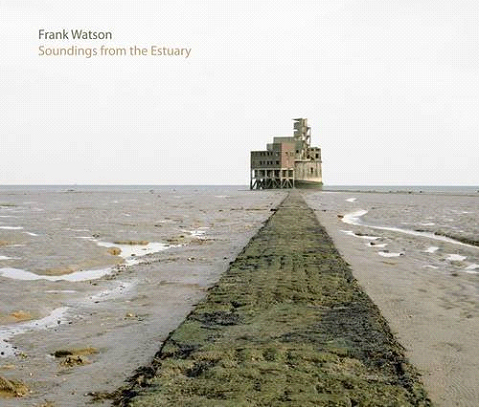
“The Soundings From the Estuary project, like its predecessor The Hush House: Cold War Sites In England observes the way specific English landscapes evolve, shaped by political, socio-economic and environmental conditions. The photographs in this book reflect a series of walks taken along the Thames Estuary, occurring in all seasons and at sporadic times over a seven-year period. Much of the Estuary is perceived as a brown field site lacking the traditional attributes of the picturesque. Prominent features include landfill sites, prisons, oil refineries and industrial debris left scattered along the river’s foreshore, amongst which also lie industrial and military ruins. Yet despite its blighted public image, the Thames estuary does have a sense of place, albeit one that is dependent on the importance of the river itself and its relation to the history of the growth of London as a city. However, this scenario conflicts with predictions of rising sea levels from global warming that would subject much of the low lying marshland of the area to flooding. The Thames Estuary is a contested landscape, with both naturalists and environmentalists seeking to preserve the existing terrain from the threats posed to its future.” Source and more info here.
Estuary; Lydia Fulleylove (Author) Colin Riches (Illustrator); 2014; Two Raven Press.
“Estuary was inspired by the River Yar Estuary in the west of the Isle of Wight. The owners have preserved the estuary in its natural state for 40 years, treating the tidal area as a wild life sanctuary and running the mixed farm as a sustainable operation. Working with artist Colin Riches, Lydia s text responds to the changing activities on the farm and the transformation of the landscape through the seasons, over the period of one year. Both words and visual images are connected by the central notion which crosses the art forms: the act of paying attention. The work conveys the immediacy of being present and reflects this quality of observation, so that the reader or viewer might come close to their experience of place. The marks made with ink, twigs, moss or fingers, earth or words are a sign of having been there, evoking the relationship with place at that moment. The work becomes a dialogue between author, artist and place, and gradually evolves to attempt to map inner as well as outer landscapes. The text has three elements: diary observations, poem meditations and voices of those who work the land.” Source
Publisher’s info – reviews and extracts here
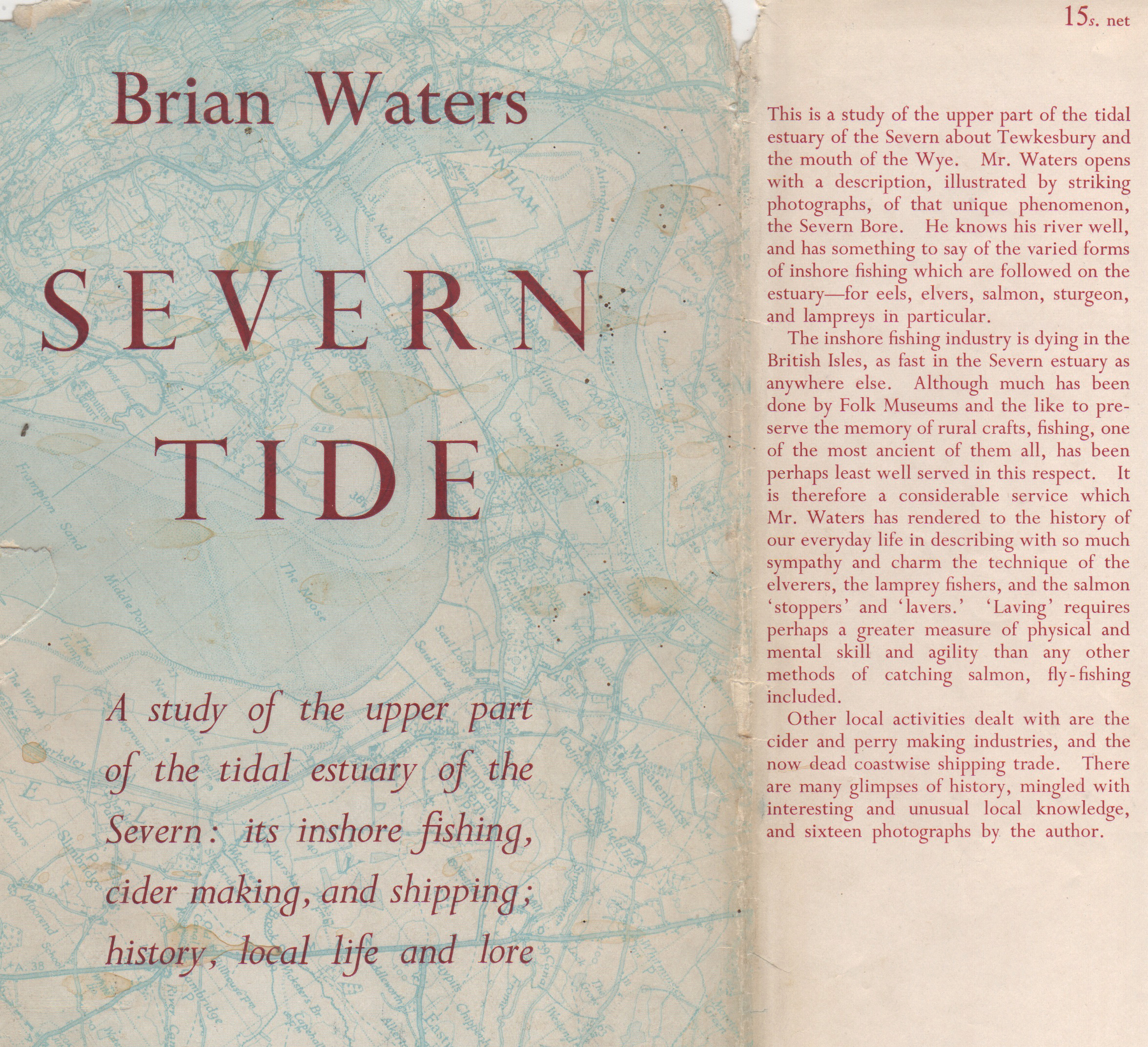
Servern Tide (1947) and The Bristol Channel (1955); Brian Waters; Dent publishers.
Books 2 and 3 of Waters triloogy of books about the River Severn The fisrt book is called Servern Stream)
These are classic mid 20th century regional topgographic studies of place which focused on geography, history, and local charater(s)
If you click on the images they should enlarge – allowing you to read the dust jacket summary
The Firth of Forth: An Environmental History; Christopher Smout and Mairi Stewart 2012; Birlinn.
This is a very interesting looking account of the environmental history of the Firth of Forth. Inevitably the tides crop in throughout the book in relation to habitiat, polluntion, land reclaimation and various other issues
This is the Amazon desrciption
The Firth of Forth combines a rich wildlife with a history of long and intense human activity around its shores and in its waters. At one time, herring, cod and haddock, with many other edible fish, were vastly more numerous, but seals and seabirds much rarer than they are now. Once, the rivers running into the Firth were so polluted that people could set fire to some of the burns; now the water is often as pure as it has ever been since records began. Illustrated with black-and-white and colour photographs, this is a capitivating exploration into the life of the Firth of Forth which considers a wide range of questions. How have people affected and exploited the wildlife, and how in turn has it determined the lives of people? What changes to the biodiversity of the Firth have taken place as a result of human interference? Why has pollution been easier to control than over-fishing? What were the unintended consequences to the natural heritage both of pollution and of cleaning-up, and what role has conservation had in bringing about changes?
There is a comprehensive review by Dr Michael Penman, University of Stirling, here
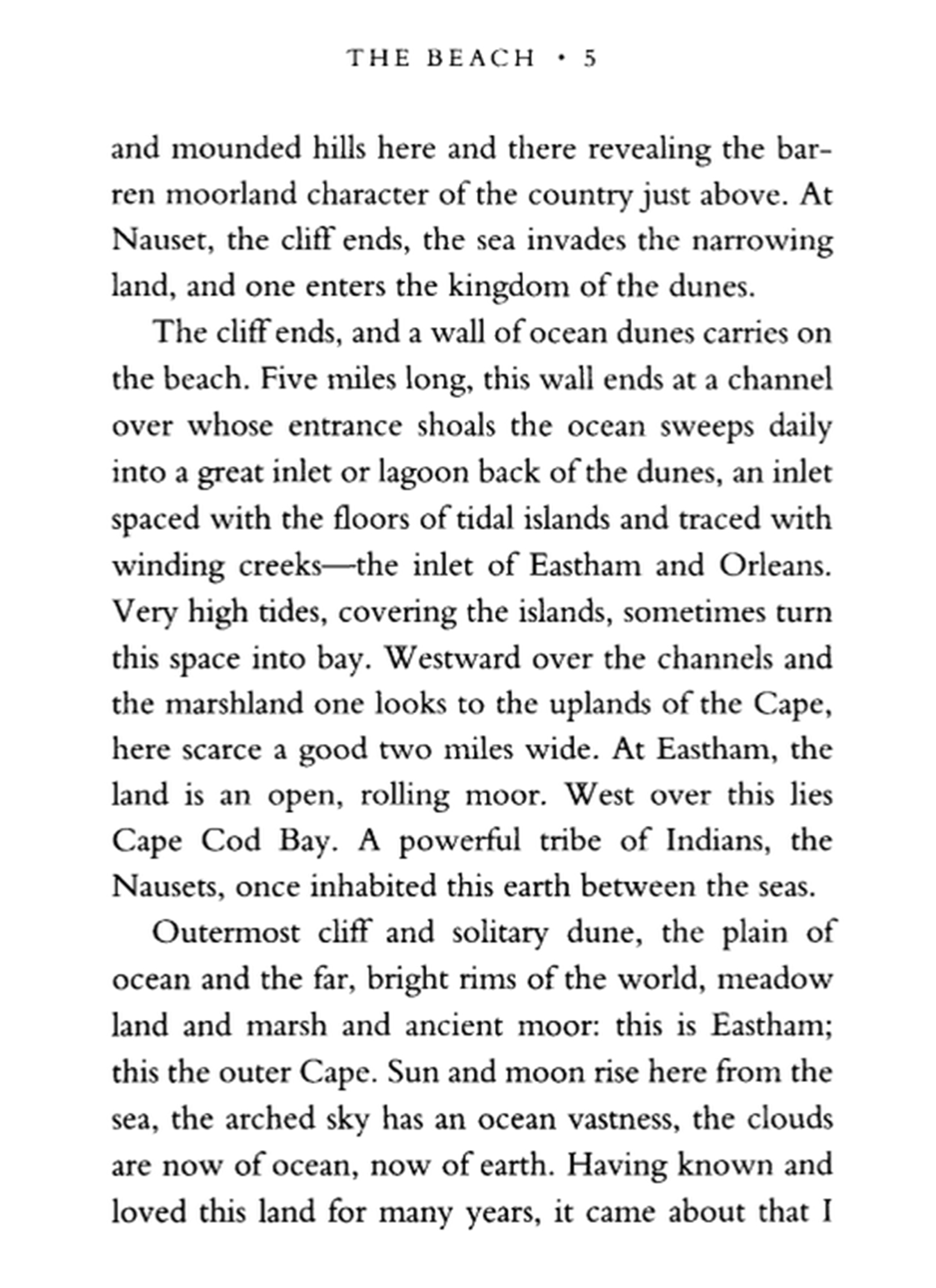
The Outermost House: A Year of Life On The Great Beach of Cape Cod; Henry Beston; 2003; Owl Books (first publiahed in 1928).
Altough centrally focused on the beauty of darkness in landscape this book is full of tidal rhythms, and the sea more generally. This is, by all accounts, a ‘classic’ so glad to have found it.
From review by Maria Popova
“This is an immensely enchanting read in its entirety, uncovering and recovering the civilization-shrouded shimmer of such beautiful phenomena as birds, the beach, midwinter, and high tide.”
Here are a few quotes from Amazon Reviews
“The passage of time is not recorded with the clock, but with the rhythms the sea, the cycles of the moon, and the changing seasons.”
“Rachel Carson once described The Outermost House as the sole influence on her writing, and Henry Beston’s account of a solitary year by the sea has the same combination of natural science and poetry.”
“When you start reading THE OUTERMOST HOUSE, you soon find yourself in a world of waves and tides, weathers and seasons.”
Here is a sample – page 5
Pilot Cutters Under Sail: Pilots and Pilotage in Britain and Northern Europe; Tom Cunliffe; 2013; Seaforth Publishing.
Click here to go to it on Amazon where you can “Search Inside”
“The pilot cutters that operated around the coasts of northern Europe until the First World War were amongst the most seaworthy and beautiful craft of their size ever built, while the small number that have survived have inspired yacht designers, sailors and traditional craft enthusiasts over the last hundred years. Even in their day they possessed a charisma unlike any other working craft; their speed and close-windedness, their strength and seaworthiness, fused together into a hull and rig of particular elegance, all to guide the mariner through the rough and tortuous waters of the European seaboard, bought them an enviable reputation. This new book is both a tribute to and a minutely researched history of these remarkable vessels. The author, perhaps the most experienced sailor of the type, describes the ships themselves, their masters and crews, and the skills they needed for the competitive and dangerous work of pilotage. He explains the differences between the craft of disparate coasts – of the Scilly Isles and the Bristol Channel, of northern France, and the wild coastline of Norway – and weaves into the history of their development the stories of the men who sailed them. Written to complement the recent histories of pilot schooners and open boat pilotage, edited and written by the author, this book will be an essential addition to the libraries of historians and enthusiasts of traditional boats.”
 Tidal Cultures
Pingback: New books added to the ‘books about tides’ list | Tidal Cultures
Pingback: We have added two new books to our non-fiction books on tides page | Tidal Cultures
Pingback: Tidal Cultures: An Introduction
Pingback: New book added to Tide Books list and a series of tide artworks by Stacy Lecy added to tide artwork list. | Tidal Cultures
Pingback: Tides: A Very Short Introduction; David George Bowers and Emyr Martyn Roberts ; 2019; Oxford Univeristy Press, added to our page of books about tides. | Tidal Cultures
All of these look intriguing!
Pingback: New entries added to pages; A (poetic) tidal glossary; Tide Related Art Works; and Non-Fiction Books about Tides | Tidal Cultures
Pingback: About this blog and how to use it. | Tidal Cultures
Pingback: The Best Books on Tides and Shorelines Recommended by Adam Nicholson | Tidal Cultures